
Online Pokies E-Wallet Australia: Market, Rules and Risks
 Available in AU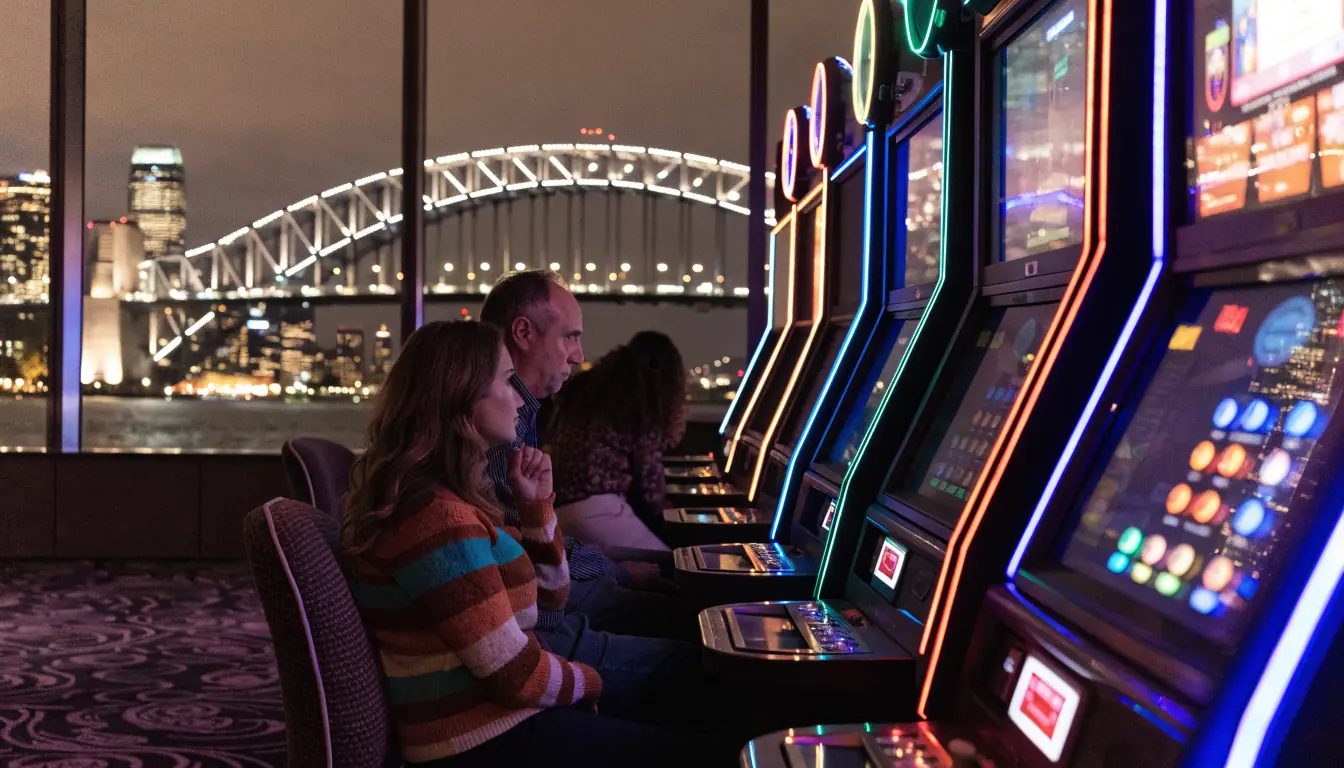
Understanding Australian Pokies: Market Size, Regulation, and Risks
Pokies run in every Australian state, in the Australian Capital Territory, and in the Northern Territory. Pubs, clubs, and casinos all carry them, which makes the machine the most geographically distributed form of gambling in the country. Before any conversation about e‑wallets, deposits, or bonus terms makes sense, the underlying market and its legal boundaries need to be laid out plainly — because online pokies for real money, in the form most search results imply, do not legally exist for Australian residents. What follows is the factual and regulatory floor that every later claim about e‑wallet pokies has to stand on.
The size of the pokies market
The scale of pokies turnover in Australia is not a niche statistic — it is one of the largest gambling flows in the country. In the financial year 2020–2021, Australians placed bets worth almost AUD 150 billion on electronic gaming machines. Turnover is not the same as loss: turnover counts every dollar wagered, including money that gets recycled through repeated bets from the same stake. The actual loss figure for that year — money that left players’ pockets for good — was about AUD 12 billion. Divided across the population, that works out to per-capita losses of AUD 608 for the 2020–2021 financial year, a figure that includes non-gamblers in the average and therefore understates what active players lost.
If you’re weighing up e-wallet friendly pokies sites for 2026, it helps to see how each casino’s licensing, deposit terms and welcome offer actually stack up before you commit any funds.
License: Curacao eGaming OGL/2024/923/0383 (Antillephone N.V.) · Bonus: up to A$2,000 + 100 free spins across 2 deposits · Min. deposit: A$30 Licensed under Curacao eGaming, this casino pairs a two-deposit welcome package worth up to A$2,000 plus 100 free spins with a low A$30 minimum deposit, making it easy to get started.
License: Curacao Gaming Authority (Jumpman Gaming Ltd) · Bonus: up to A$6,600 + up to 250 free spins across 4 deposits Operated by Jumpman Gaming under a Curacao Gaming Authority license, it offers one of the larger welcome packages here, spread across four deposits with up to A$6,600 and 250 free spins.
License: Curacao · Bonus: up to A$2,000 A Curacao-licensed casino offering a straightforward welcome bonus of up to A$2,000, suited to players who want a simple entry offer.
License: Curacao eGaming (Hollycorn N.V., since 2017) · Bonus: 225% up to A$1,540 + 600 free spins across 4 deposits, 20x wagering · Min. deposit: A$20-30 (depends on the offer) Backed by Hollycorn N.V. and licensed under Curacao eGaming since 2017, it offers a 225% bonus up to A$1,540 with 600 free spins across four deposits, 20x wagering, and a modest A$20-30 minimum deposit depending on the offer.
License: Curacao eGaming (Dama N.V.) · Bonus: up to A$10,000 + 180 free spins, 40x wagering Licensed via Curacao eGaming under Dama N.V., this casino stands out for a sizeable welcome offer of up to A$10,000 plus 180 free spins, though the 40x wagering requirement is worth noting.
License: Tobique Gaming Commission · Bonus: up to A$8,000 + 400 free spins across 4 deposits · Payout speed: crypto ~10-15 minutes, fiat 1-5 days · Min. deposit: A$30 Licensed by the Tobique Gaming Commission, this casino offers a generous four-deposit package up to A$8,000 with 400 free spins, fast crypto payouts of around 10-15 minutes, fiat withdrawals within 1-5 days, and a A$30 minimum deposit.
License: Curacao, operated by Dama N.V. · Bonus: 325% up to 5.25 BTC + 250 free spins across 4 deposits Operated by Dama N.V. under a Curacao license, it’s notable for a crypto-focused welcome bonus of 325% up to 5.25 BTC plus 250 free spins across four deposits.
License: Curacao (operating since 2017) · Bonus: 250% up to A$2,000 + 50 free spins on the first of six deposits · Min. deposit: A$20 Running since 2017 under a Curacao license, it offers a 250% bonus up to A$2,000 with 50 free spins on the first of six deposits, plus a low A$20 minimum deposit for easy access.
Bonus: 240% up to A$4,100 + 300 free spins Offers a 240% welcome bonus up to A$4,100 plus 300 free spins, giving newcomers a solid starting incentive.
License: Curacao · Bonus: up to A$10,000 multi-stage + 500 free spins · Min. deposit: A$20 (POLi) Curacao-licensed with a multi-stage welcome package reaching up to A$10,000 and 500 free spins, plus a low A$20 minimum deposit via POLi for convenient funding.
A more recent figure, reported for 2023, put pokies turnover at AUD 191.2 billion for that year, according to complyadvantage.com. That number is not directly comparable to the FY2020–2021 turnover figure — different sources, different reporting periods, different methodologies — and it should be read as a separate data point rather than proof of a trend. Anyone trying to chart growth or decline in the pokies market from these two figures alone would be reading more into them than the numbers support.
Australia’s share of the world’s pokies fleet is where the sourcing gets genuinely inconsistent. One figure puts Australia’s share of the world’s pub and club poker machines at 3%. Another puts it at roughly 18%. These are not close enough to be rounding differences — they describe different realities of how concentrated the Australian market is relative to the rest of the world. Where sources disagree this sharply, the honest position is to flag the disagreement rather than pick the number that sounds more dramatic or more modest. Both figures circulate under the same claim, and there is no clear way from the available material to say which one is current or which one covers a broader machine category.
Winnings from pokies, and from gambling generally, are not taxed in the hands of the player in Australia. The tax burden sits with operators instead, and it is not uniform: taxation of gambling operators varies by state and by the type of gambling service offered, so a club running pokies in one state faces a different tax structure than a casino running them in another. There is no single national pokies tax rate to quote.
Illegal Online Pokies
Offering real‑money online pokies to Australian residents is prohibited under the Interactive Gambling Act 2001; operators doing so breach federal law.
The legal framework: what is actually allowed
The Interactive Gambling Act 2001 is the piece of Commonwealth legislation that governs this entire space, and its stated purpose is harm minimisation rather than market growth. It makes it an offence for online operators to offer real-money gambling to Australian residents. This is the point where a lot of casual research on "online pokies Australia" goes wrong: the Act prohibits online casino-style games — slots, poker, blackjack, roulette — from being offered to Australian residents by any operator, full stop. There is no licence that turns this into a legal offering. No domestically licensed real-money online casino operator exists for Australian players, and none can exist under current law, because it is not possible to obtain a licence to operate an online casino domestically in the first place.
This creates a specific asymmetry worth stating clearly: the law targets operators, not players. It is not illegal for an individual Australian to play at an offshore-licensed online casino. The offence sits with whoever is offering the game to Australian residents, not with the resident who logs in. That distinction explains why offshore sites remain accessible in practice while carrying no legal standing domestically — and why any page suggesting there is a "licensed Australian online pokies operator" is describing something that does not exist.
Online sports betting sits in a different category entirely. It is legal under state and territory licences, and phone-based live betting is permitted. Live, in-play online betting through a website or app, however, is prohibited federally under the same Interactive Gambling Act 2001 that bans online casino games. Lotteries are also licensed and legally offered. So the legal map has three distinct zones — sports and racing wagering (licensed), lotteries (licensed), and online casino-style gambling including pokies (prohibited, with no licensing path) — and conflating them is where most confusion about "legal online pokies" originates.
There is no public register of gambling licensees in Australia that a player could consult to check an online pokies operator’s credentials, because no domestic licence for that activity exists to be checked. Advice to "verify the operator’s licence" or "only play at licensed sites" is meaningless in this specific context — not a matter of caution, but a statement that assumes a regulatory structure the market does not have for this product.
Legal Risk
Australian players accessing offshore online pokies do not break the law themselves, but they may be exposed to unregulated operators and potential financial loss.
Age matters here too. The minimum legal gambling age in Australia is 18. Survey data cited in industry sources indicates that gambling participation among minors is not a marginal problem: almost one in three 12–17-year-olds in Australia gambles in some form, and that figure jumps to 46% among 18-year-olds — the age bracket at the legal threshold. These numbers sit behind the strict advertising and access controls that apply across the sector, including bans on targeting minors in any advertising channel and mandatory age gating on gambling-related sites.
Where the money goes: economic weight versus harm
The scale of pokies turnover translates into real fiscal weight for state governments and real damage recorded in public health terms — the per-capita loss figure of AUD 608 in FY2020–2021 is the clearest single number connecting the two. It is worth being precise about what that figure does and doesn’t say: it is a population-wide average, meaning it dilutes the experience of both non-gamblers and heavy losers into one number. It says nothing about distribution — how much of that AUD 12 billion in total losses came from a small number of high-frequency players versus a broad base of occasional ones. No source among the verified facts breaks that distribution down, so no such breakdown should be assumed.

No Australian-licensed casino can legally offer Aristocrat pokies — here's why offshore Curacao and Malta…

Pokies are used widely across pubs, clubs, and casinos, which means the AUD 12 billion loss figure is spread across a genuinely large number of venues and machines rather than concentrated in a handful of casino floors. This distribution is itself part of why the machines are hard to monitor centrally — a problem that becomes central once the discussion turns to money laundering.
Money laundering through pokies: the mechanics
Pokies present a specific structural weakness that other gambling products don’t share to the same degree: high cash throughput combined with limited transaction traceability. That combination is what regulators and financial crime researchers point to as the reason pokies attract laundering activity. According to complyadvantage.com, money mules are recruited specifically to launder money through pokies — individuals who are given cash to feed into machines on someone else’s behalf, distancing the actual source of funds from the transaction record.

The basic laundering mechanic works like this: someone inserts a large sum of cash into an electronic gaming machine, performs a minimal amount of actual gambling, and then cashes out. The withdrawal then reads as “winnings” rather than as the deposit it actually was, creating a paper trail that looks legitimate on its face. A related variant involves purchasing winning tickets directly from other players — the offender pays a genuine winner face value or above for their payout ticket, and redeems it themselves, converting cash of unclear origin into a traceable, apparently legitimate win.
A further technique is structuring across venues: rather than depositing one large sum that would trigger reporting obligations, the amount is broken into smaller deposits spread across multiple venues, each one individually too small to draw attention. This deliberately works around the reporting thresholds built into the AML system.
Red flags regulators are trained to watch for
AUSTRAC issued a guide in 2024 specifically to help operators and staff recognise money-laundering red flags in the pokies environment. The indicators it lists are not abstract — they describe observable patron behaviour:
- Unusually high cash access relative to a patron’s apparent circumstances or occupation.
- Large or repeated cash insertions into a machine followed by minimal actual play and an immediate cash-out.
- Frequent small redemptions across different venues within a short window of time — the signature of structuring.
- Refusal to provide identification, or use of multiple player cards by the same individual.
- Casino disbursement checks and cash transfers that don’t align with ordinary play patterns.
- Certain occupations flagged as carrying disproportionate cash-handling risk in AUSTRAC’s guidance.

None of these signals is conclusive on its own — a big win genuinely happens, and cashing out quickly after one is not inherently suspicious. What turns a pattern into a red flag is repetition, combined with minimal genuine engagement with the game and behaviour that avoids identification or reporting thresholds.
The compliance burden on operators
AUSTRAC’s obligations scale with the size of the operation, and the threshold that separates light-touch from heavy compliance is machine count rather than turnover:
| Operator size | Obligations |
|---|---|
| Up to 15 pokies | Register with AUSTRAC; keep identification records; submit suspicious matter reports |
| More than 15 pokies | All of the above, plus: appoint a compliance officer; conduct risk assessments; implement AML/CFT programs; perform customer due diligence; report cash transactions over AUD 10,000 |
The AUD 10,000 cash transaction reporting threshold is the anchor figure structuring schemes are built to avoid — which is exactly why AUSTRAC’s guidance treats repeated transactions just under that line, spread across venues, as a pattern worth flagging rather than a coincidence.
Failure to meet these obligations carries a graduated set of consequences: remedial directions first, then infringement notices, then civil fines, on top of whatever reputational damage follows from public enforcement action. In New South Wales, the stakes for casino operators specifically are considerably higher: an amendment to the Casino Control Act 1992 allows NSW casino operators to be fined up to AUD 100 million for compliance failures — a figure that puts NSW casino-level enforcement in a different order of magnitude from the AUSTRAC registration-and-reporting regime that applies to smaller pub and club operators.
The push toward cashless pokies
The regulatory direction is unambiguous: away from cash, toward account-based systems that leave a full transaction record. The 2022 NSW Islington Report — commissioned in response to laundering concerns raised by the NSW Crime Commission — recommended making all NSW pokies cashless by the end of 2028, according to the report’s own findings as summarised by industry commentary. That target is a recommendation on record, not a confirmed legislative deadline binding every venue, and it should be read as such rather than as settled fact about what will exist in NSW by that date.
The NSW government aims to make all pokies cashless by the end of 2028, moving towards account‑based systems that improve traceability.
The logic behind the push is straightforward and is echoed across multiple sources in the compliance space: transparent, account-based pokies provide full traceability of deposits, gameplay, and withdrawals, closing off the anonymity that cash-fed machines currently allow. According to facctum.com, adoption of cashless, account-based pokies improves traceability and reduces anonymity for exactly this reason — every dollar that moves through an account carries an identity attached to it, unlike cash inserted directly into a machine. Regulators’ recommendations converge on the same three points: tighter customer due diligence, closer transaction monitoring, and continued adoption of cashless gaming systems as the structural fix rather than reliance on staff vigilance alone.
For everyday cash-based pokies today, none of that traceability yet applies at scale — which is precisely the gap the AUSTRAC red-flag guidance and the compliance officer requirements are designed to patch in the meantime, until account-based systems become the default rather than the exception.
e‑wallets don’t legalise pokies
Using an e‑wallet does not change the fact that online casino‑style pokies remain illegal for Australian residents.
Why this framework matters before talking about e‑wallets
Every one of the points above sits upstream of any discussion about e‑wallet-based pokies play. E‑wallets are, in effect, an account-based payment layer — closer in spirit to the cashless direction regulators are pushing than to a coin slot. But no e‑wallet transaction changes the underlying legal position: online casino-style pokies remain prohibited for Australian residents under the Interactive Gambling Act 2001, regardless of what payment method moves the money. A platform accepting AUD through an e‑wallet is not thereby operating under an Australian licence, because there is no such licence to hold. That legal boundary doesn’t shift depending on whether the deposit method is cash in a machine, a bank transfer, or a digital wallet — it is fixed at the level of the activity itself, not the payment rail carrying it.
That distinction — between how money moves and whether the underlying activity is lawful to offer — is the one that gets lost fastest in casual discussion of "e‑wallet pokies," and it’s the one worth holding onto going into the next section.
e‑Wallet Pokies with No Deposit Bonus: What Players Need to Know
A no-deposit bonus offers credit or free spins on e-wallet pokies without requiring a funded account first. In markets where such offers exist, the mechanic is simple: register, verify identity, receive a small allocation, then meet conditions before any winnings become withdrawable.

For Australian residents, this mechanic runs into the legal framework covered above. The Interactive Gambling Act 2001 prohibits operators from offering online casino games, including pokies, to people in Australia. There is no domestic licence that permits real-money online pokies, no-deposit or otherwise, and no public register where such a licence could be checked. An offer advertised as available to Australian players is not something a local regulator has cleared.
Where no-deposit bonuses do appear, tighter rules apply than the ones seen on other rewards. Wagering requirements must be shown before the offer is accepted, and identity verification against government-issued ID is required before any withdrawal — the same checks that apply to deposits and cash-outs elsewhere in the market. Given that no-deposit offers exist outside any framework a resident can verify, the terms attached to them carry more weight than the word "free" suggests.
What law governs online gambling in Australia?
The Interactive Gambling Act 2001 is the Commonwealth legislation that governs this space, making it an offence for online operators to offer real-money casino-style gambling to Australian residents.
What is the minimum legal gambling age in Australia?
The minimum legal gambling age in Australia is 18.
How can I verify if a gambling operator is legal?
For online pokies, you cannot verify the operator because no domestic licence exists to be checked. It is not possible to obtain a licence to operate an online casino in Australia, so any claim of a licensed online pokies operator is describing something that does not exist.
Published by the Casino Payment Guide team.