
Instant PayID Withdrawal Real Money Australia: How It Works
 Available in AU
How instant PayID withdrawals work for Australian real‑money players in 2026
A withdrawal request never travels in one continuous line from casino balance to bank account. It moves through two separate systems that operate on entirely different clocks, and the total time a player waits is the sum of both. The first clock belongs to the casino: staff or automated fraud checks decide whether the request is released. The second clock belongs to the payment rail itself — PayID, crypto network, or bank transfer — and that part runs on infrastructure the casino doesn’t control. Understanding where one clock ends and the other starts explains most of the confusion around what "instant" actually means.
Stage 1: the casino’s own processing window
Before any money moves, the operator has to approve the request internally. This is the stage industry reviews refer to as Stage 1, and it’s the part that varies most between operators. According to one industry review of Australian-facing casinos, automated approval typically clears in 5 to 30 minutes, while manual approval — where a member of the payments team physically checks and releases the transaction — takes 2 to 24 hours. Both figures assume a standard case: an account that’s already verified, a withdrawal size the casino considers routine, and no outstanding bonus wagering. The same review notes that first withdrawals or unusually large ones can take longer than either range, because they’re more likely to be pulled aside for a closer look regardless of which system the casino normally uses.

The distinction between automated and manual matters more than most players expect. An automated system checks a fixed set of conditions — verified identity, cleared wagering, matching payment details — and if everything lines up, it releases funds without a person touching the request. A manual system routes the same request to a staff member’s queue. That queue doesn’t run continuously. It follows shift patterns, and this is where day and time of the request start to matter as much as the casino’s advertised processing window.
The same industry review makes the point directly with a timing example: a request submitted at 11 pm on a Sunday to a casino that reviews withdrawals manually may sit untouched until Monday, not because anything went wrong, but because there was no one rostered to look at it. Staffed batches mean the casino works through requests in groups at set points during the day, so timing a withdrawal for the middle of a business day, rather than a weekend night, avoids an entirely avoidable wait. This isn’t a rule that applies to every operator, since batch scheduling differs by casino, but it explains why identical withdrawal amounts at the same casino can produce noticeably different wait times depending on when they were submitted.
Manual review risk
If your withdrawal is processed manually, it can be delayed by several hours or even days, especially on weekends or outside staff shifts. This is the most common cause of unexpected wait times.
Beyond timing, three specific triggers reliably push a withdrawal from the fast lane into the slow one:
- Incomplete or pending identity verification. According to the same review, incomplete KYC is the single largest cause of withdrawal delay across the board — ahead of withdrawal size, payment method, or time of submission. A request can’t clear an automated check if the account isn’t fully verified, and it can’t clear a manual one any faster either, since staff still need the same documents before releasing funds.
- Withdrawal size. First withdrawals above a threshold in the AU$2,000–AU$5,000 range often trigger a manual security review even at casinos that otherwise process most payouts automatically, per the same source. This isn’t necessarily about suspicion — it’s a standard control point that larger sums pass through regardless of account history.
- Name mismatch. The name on the casino account has to match the name on the receiving bank account, card, or crypto exchange exactly. A withdrawal sent to an account under a different name — a spouse’s bank details, a business account, a nickname used at signup — will stall regardless of how fast the casino’s systems normally are, because the payment can’t be reconciled against the identity on file.
None of these three is really a separate problem; they’re all versions of the same one. The casino’s Stage 1 clock only runs fast when there’s nothing left for a human to check. Verification, matching details, and staying under the threshold that triggers extra scrutiny are what keep a request in the automated lane in the first place.
Stage 2: the payment rail itself
Once the casino releases funds, the second clock starts, and this one belongs to the infrastructure moving the money, not the casino. This is where PayID’s advantage over other methods becomes concrete rather than promotional.
PayID routes through Australia’s New Payments Platform (NPP), which settles transfers in under 60 seconds. Once a casino has approved the withdrawal, the money is in the account inside a minute — there’s no overnight batch, no business-day cutoff, and no weekend pause specific to the payment rail itself. That’s the part of "instant" that’s genuinely instant, as long as Stage 1 has already cleared.

Bank transfers via BECS, the older clearing system still used by some casinos and banks, take 1 to 3 business days. This isn’t a casino delay — it’s the settlement window of the clearing system itself, and it applies even after the casino has approved the withdrawal instantly on its end. A payout approved on a Friday afternoon through BECS can land the following week purely because of how the rail processes business days, regardless of how quickly the casino released it.
Crypto, most commonly Bitcoin, depends on blockchain confirmation rather than a banking clearing house. A Bitcoin transaction typically needs 10 to 60 minutes for confirmations, according to the same industry source — a range that reflects network congestion at the time of the transaction rather than anything the casino or the player controls. That variability is the main practical difference between crypto and PayID: PayID’s settlement time is close to fixed, while crypto’s is a range that depends on conditions outside the transaction itself.
The table below sets out Stage 2 timing side by side, based on the figures above:
| Method | Settlement layer | Typical Stage‑2 time |
|---|---|---|
| PayID | New Payments Platform (NPP) | Under 60 seconds |
| Bitcoin | Blockchain confirmation | 10–60 minutes |
| Bank transfer | BECS clearing | 1–3 business days |
Because Stage 1 and Stage 2 are independent, the fastest possible outcome is an automated casino approval paired with a PayID transfer: a request that clears the casino’s checks in minutes and then settles in under a minute more. The slowest realistic outcome is a manual review over a weekend paired with a BECS transfer, where both clocks run long for unrelated reasons — one because no staff member has looked at the queue yet, the other because the clearing system doesn’t move on non-business days.
Choosing a method by withdrawal size, not by habit
The same industry review that supplied the processing-time figures above also frames its recommendation around withdrawal size rather than personal preference, and the logic holds up on its own terms. PayID is put forward as the default method for withdrawals under AU$1,000, on the basis that NPP settlement is effectively immediate and there’s no fee structure to weigh against the convenience. For anyone withdrawing under that threshold, there’s little reason to route the payment anywhere else — the rail is fast, and there’s no volatility risk to manage since the amount is exchanged in Australian dollars from the outset.

For larger withdrawals, the same source recommends USDT on the TRC-20 network instead. The reasoning is specific to what larger sums expose: a stablecoin like USDT is pegged to the US dollar, so the amount received doesn’t move while the transaction is pending, unlike Bitcoin or Ethereum, where a price swing during confirmation time can change the real-world value of the payout. The same review notes that TRC-20 transfers usually cost under AU$1 in network fees, which is negligible against a large withdrawal but would be a poor trade-off on a small one, where PayID’s lack of any fee at all is the simpler option. This is a recommendation drawn from one industry source rather than a fixed rule followed by every operator, and it’s worth treating as exactly that — a sensible default rather than a universal standard, since fee structures and supported networks differ by casino.
The practical split, then, isn’t about which method is "better" in the abstract. It’s that PayID’s speed advantage matters most when there’s no volatility risk to offset, which is the case for smaller, routine withdrawals, while stablecoin crypto’s fee and price-stability advantage matters more once the amount at stake makes currency movement during confirmation time a real consideration.

Verification: the step that decides which clock runs fast
Every timing figure above assumes identity verification is already settled. That assumption does most of the work. Completing identity verification before making a first deposit — rather than waiting until the first withdrawal request forces the issue — is what keeps a withdrawal in the automated lane described in Stage 1. Identity verification, referred to across the market as KYC, is usually completed within 24 hours once documents are submitted, but that 24-hour window only starts once a player actually submits them. Left until the point of the first withdrawal, it adds a full extra wait on top of whatever Stage 1 and Stage 2 would otherwise take — and, per the same industry review, incomplete KYC is the leading cause of withdrawal delay overall, ahead of any other factor examined.
Verification documents typically need to demonstrate two things: that the identity matches the account, and that the account matches the payment method the funds are being sent to. This is where the exact-name-match rule becomes unavoidable rather than a technicality. A PayID linked to a different legal name, a bank account held jointly under a name that doesn’t match the ID on file, or a crypto exchange account registered to someone else will all stall a withdrawal at the point of Stage 1, regardless of how quickly the casino processes routine requests or how fast the underlying payment rail is. The rail can’t fix a mismatch further up the chain.

None of this is unique to PayID withdrawals specifically — it applies to bank transfers and crypto payouts as well — but it matters more for PayID precisely because PayID’s Stage 2 is so fast that Stage 1 becomes the only variable left. With a bank transfer, a day or two of BECS clearing time can absorb a verification delay without the player necessarily noticing the difference. With PayID, an unfinished verification step is the difference between money arriving in minutes and a request sitting untouched for a day or more, because there’s nothing else left to blame the wait on.
What "instant" actually describes
Put together, "instant PayID withdrawal" describes Stage 2 only — the roughly one-minute settlement window that the NPP guarantees once a casino has released the funds. It doesn’t describe Stage 1, which depends on the casino’s own checks, staffing pattern, and the size and history of the specific request. A player who has completed verification ahead of time, keeps the withdrawal below the threshold that tends to trigger manual review, and submits during a period a manual-review casino is actively working through requests will typically see both stages move quickly. A player missing any one of those conditions will find that the "instant" part of the transfer was never the bottleneck — it was everything that happened before the money was released to move at all.
Top Australian casinos offering instant PayID withdrawals (2026)
If you’re after fast PayID withdrawals in 2026, it helps to check licensing, deposit minimums and bonus terms before signing up, since these details directly affect how smoothly your cashouts go.
License: Curacao eGaming OGL/2024/923/0383 (Antillephone N.V.) · Bonus: up to A$2,000 + 100 free spins across 2 deposits · Min. deposit: A$30 Licensed under Curacao eGaming, this casino offers a two-deposit welcome package with free spins and a low A$30 minimum deposit, making it accessible for newcomers.
License: Curacao Gaming Authority (Jumpman Gaming Ltd) · Bonus: up to A$6,600 + up to 250 free spins across 4 deposits Operated by Jumpman Gaming under a Curacao Gaming Authority license, it stands out with a sizeable four-deposit bonus package that includes a generous batch of free spins.
License: Curacao · Bonus: up to A$2,000 Holding a Curacao license, this casino keeps things simple with a straightforward welcome bonus of up to A$2,000.
License: Curacao eGaming (Hollycorn N.V., since 2017) · Bonus: 225% up to A$1,540 + 600 free spins across 4 deposits, 20x wagering · Min. deposit: A$20-30 (depends on the offer) Backed by Hollycorn N.V. and licensed since 2017, it pairs a large four-deposit bonus with a substantial free spins allowance and a wagering requirement of 20x, plus a modest deposit minimum.
License: Curacao eGaming (Dama N.V.) · Bonus: up to A$10,000 + 180 free spins, 40x wagering Licensed via Curacao eGaming under Dama N.V., it offers one of the larger welcome bonuses on this list along with free spins, though the 40x wagering requirement is worth noting.
License: Tobique Gaming Commission · Bonus: up to A$8,000 + 400 free spins across 4 deposits · Payout speed: crypto ~10-15 minutes, fiat 1-5 days · Min. deposit: A$30 Licensed by the Tobique Gaming Commission, this casino is notable for fast crypto payouts within minutes, with fiat withdrawals taking a few days, alongside a four-deposit welcome bonus and low deposit minimum.
License: Curacao, operated by Dama N.V. · Bonus: 325% up to 5.25 BTC + 250 free spins across 4 deposits Operated by Dama N.V. under a Curacao license, it caters to crypto players with a bonus expressed in Bitcoin plus free spins across multiple deposits.
License: Curacao (operating since 2017) · Bonus: 250% up to A$2,000 + 50 free spins on the first of six deposits · Min. deposit: A$20 Running since 2017 under a Curacao license, it offers a multi-deposit welcome bonus with free spins on the first deposit and a low entry deposit requirement.
Bonus: 240% up to A$4,100 + 300 free spins This casino offers a solid welcome bonus combined with a generous number of free spins for new players.
License: Curacao · Bonus: up to A$10,000 multi-stage + 500 free spins · Min. deposit: A$20 (POLi) Licensed in Curacao, it features a multi-stage bonus structure with a large spins package and accepts a low minimum deposit via POLi.
Licensing status comes first, because it is the only filter that separates a payable operator from a frozen account. Every casino named below holds a Curaçao licence (or equivalent) and does not appear on the ACMA blocked register as of 2026. That register check matters more than any payout claim: an operator can advertise instant withdrawals all it wants, but if access is blocked at the ISP level for Australian users, the speed of its payment rail is irrelevant.
Reminder on the legal boundary before the list: none of these operators is licensed to offer casino games to Australian residents domestically, because no such domestic licence exists under the Interactive Gambling Act 2001. Playing at an offshore-licensed casino is not illegal for an individual player — the Act targets operators, not users — but nothing below should be read as "regulated" in the way sports betting licensed by a state or territory is regulated. There is no public register to check these operators against beyond the ACMA blocklist, and that list only tells you who is banned, not who is trustworthy.
According to one industry review of the sector, all 15 casinos it tested support at least one fast withdrawal method for Australian players — PayID, crypto, or both. That is a floor, not a differentiator: every operator on a shortlist like this will claim to be fast. What actually varies is which rail is offered, how many alternatives sit alongside PayID, and what the same review measured as median payout time for each. Those numbers came from one testing round at one point in time; a casino’s processing queue, staffing, or payment partner can change well before this page is updated again.

Casinos with the broadest fast-withdrawal method range
Casinonic supports PayID, MiFinity and crypto withdrawals — a wider spread than casinos relying on PayID alone. In the same review, crypto payouts were received in 30–60 minutes, while MiFinity withdrawals cleared in under four hours. That gap illustrates a point carried over from the general withdrawal process: the rail chosen after Stage 1 approval, not the casino’s processing itself, decides most of the remaining wait. PayID timing for Casinonic specifically was not part of that published data, which is worth noting rather than guessing at — if PayID speed is the deciding factor for a given player, it is not confirmed here and needs checking directly with the operator before relying on it.
Kingmaker goes further on method count, with more than 15 withdrawal options listed in that same review, including crypto, e-wallets such as Jeton and Sticpay, and a handful of fiat options. Breadth here works as a fallback rather than a speed guarantee — if one rail is delayed, congested, or temporarily unavailable, having over a dozen alternatives means a stuck withdrawal is a routing problem, not a dead end. What that source did not report is a PayID-specific median time for Kingmaker, so it belongs on a list of casinos with fast-withdrawal options, not on a ranked list of the fastest PayID payouts specifically.
Casinos benchmarked on crypto speed
Three operators appear in that industry review with measured median cryptocurrency withdrawal times, useful for comparison even though the coin isn’t PayID:
| Casino | Coin | Median withdrawal time |
|---|---|---|
| Wild Tokyo | Bitcoin | 13 minutes |
| GoldenCrown | Bitcoin | 14 minutes |
| Skycrown | Litecoin | 22 minutes |
These figures sit inside the blockchain-confirmation window described for Bitcoin generally — 10 to 60 minutes — which places Wild Tokyo and GoldenCrown toward the fast end of that range rather than outside it. Skycrown’s Litecoin figure runs a bit longer, though still well under a full confirmation cycle for slower networks. None of these three numbers is a PayID figure; they are included because a player choosing between PayID and crypto at one of these three operators now has a concrete number to weigh against PayID’s own settlement time, rather than a vague sense that "crypto is fast too."
What differs, and what doesn’t
Licensing status is identical across all fifteen casinos referenced by that review: Curaçao or equivalent, clear of the ACMA blocklist. Verification requirements are also uniform in practice — every operator paying out to an Australian player needs government-issued ID confirmed before funds move, regardless of which of these names is chosen. That is not a casino-specific perk; it is the baseline set by the market’s KYC rules, covered in full in the withdrawal-process breakdown above.
Where operators genuinely differ is in the number and mix of fast-withdrawal rails on offer, and — for the subset actually measured — how quickly each rail pays once approved. A casino offering PayID plus five crypto options gives more routing flexibility than one offering PayID alone, but flexibility is not the same as PayID itself being faster at one operator than another. Reliable, operator-specific PayID median times, as distinct from crypto benchmarks, are not something these sources published, and no other figure should be assumed to fill that gap.

Reading a shortlist like this correctly
A casino named here for a fast crypto median time is not thereby confirmed fast on PayID, and a casino praised for method count is not thereby confirmed fast on any single rail. The distinction matters because Stage 1 — the casino’s own approval queue — behaves the same regardless of which withdrawal method comes after it. A first-time or unusually large withdrawal can still trigger the same manual review at any of these fifteen operators, PayID or not, and a request submitted outside staffed hours can still sit until the next business day. Method choice affects the second half of the wait, not the first.
Before selecting an operator from a list like this, the practical checks are the same ones that apply to the market generally: confirm the licence shown in the footer, confirm the operator isn’t on the ACMA blocklist, and complete identity verification ahead of any withdrawal rather than at the point of cashing out. None of that changes because a casino happens to support PayID or a fast crypto rail — it is the floor every payout method sits on top of.
Responsible gambling: Gambling involves financial risk. Only wager what can be afforded to lose. Support is available through the National Gambling Helpline and Gambling Help Online for anyone concerned about their gambling or someone else’s. Must be 18+ to gamble.
This page contains affiliate links. Casino Payment Guide may earn a commission if an account is opened through a link on this page, at no extra cost. This does not affect the placement or ranking of any operator listed.
Instant PayID withdrawals with no‑deposit bonuses – what to expect
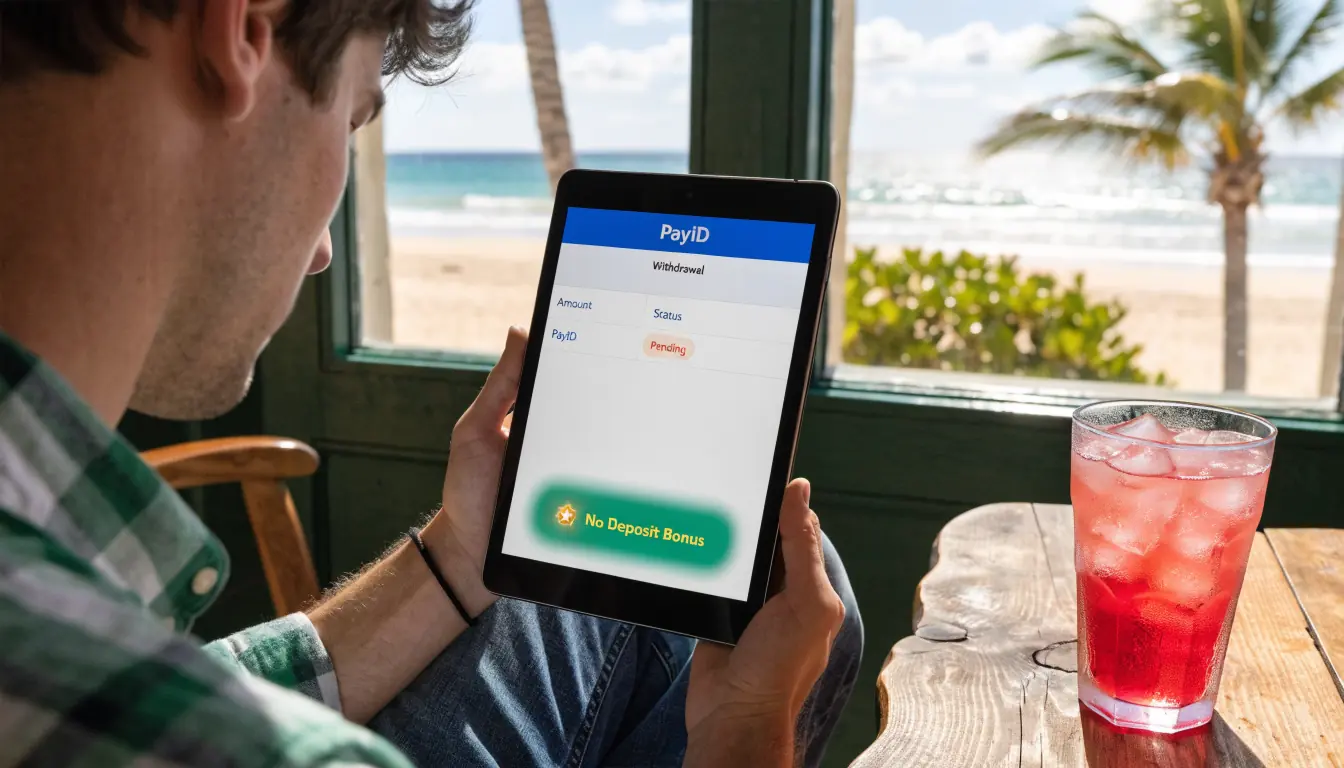
A no-deposit bonus reaches an account before any money does, which changes what "instant PayID withdrawal" actually means in practice. The offer looks free at the point of signup, but the wagering attached to it decides whether the winnings ever reach a bank account at NPP speed or sit behind a clearing period first. The bonus itself costs nothing; the conditions around it are the real price.
Wagering is the default, not the exception
Standard practice across the market requires the bonus amount, or the winnings generated from it, to be played through a set number of times before any of it becomes withdrawable. Until that wagering is cleared, a PayID withdrawal request either gets rejected outright or converts only the wagered-through portion into real balance. The one-second settlement of PayID doesn’t apply to money that hasn’t finished clearing the bonus terms — the payment rail is fast, but it only moves what the casino has already released.
One operator’s terms break from this pattern: Goldenbet’s cash bonus carries no wagering requirement, according to the operator’s own published terms. That structure is the exception industry-wide, not a benchmark to expect elsewhere. Most no-deposit offers still tie the bonus to a multiplier, a time limit on clearing it, and a cap on the size of individual bets placed while wagering is in progress.
Wild Tokyo’s bonus terms illustrate what that combination looks like in practice: 50x wagering, a five-day window to clear it, and a maximum bet of AU$8 while the requirement is active. Miss the window or place a bet above the cap and the bonus — along with anything won from it — is typically forfeited under standard terms of this kind. A no-deposit offer with a 50x multiplier and a five-day clock is not a shortcut to a fast payout; it is a fixed amount of time-pressured play that has to happen before PayID becomes relevant at all.
Verification decides whether the bonus pays out on time
A no-deposit bonus is the scenario where identity verification is most likely to get skipped, because no card or bank detail was needed to open the account. That’s precisely why it becomes the first thing that stalls a withdrawal later. Completing identity verification before the first deposit avoids delays at the withdrawal stage — and with a no-deposit bonus, there frequently isn’t a first deposit early on to trigger that check automatically. The verification step ends up happening at the worst possible time: right when a player is trying to cash out bonus winnings.
Daytona Spin requires verification to be completed before the first withdrawal is processed, which is a direct illustration of the same principle applied by name. Anyone holding no-deposit bonus winnings who hasn’t yet submitted ID should expect that step to happen before a single PayID transfer moves, regardless of how quickly the operator’s payment processing otherwise runs. The gap between "wagering cleared" and "money in the bank account" is, in this scenario, almost entirely a KYC gap.
How no-deposit offers differ from standard bonus programmes
| Standard deposit bonus | No-deposit bonus | |
|---|---|---|
| Funds required to activate | Yes | No |
| Wagering requirement | Applies, in almost all cases | Applies, except stated zero-wagering terms such as Goldenbet’s cash bonus |
| ID verification trigger point | Often prompted at first deposit | Frequently deferred until first withdrawal is requested |
| Withdrawal via PayID | Available once wagering clears and KYC is complete | Same requirement, but KYC gap is more likely to cause delay |
The functional difference isn’t the wagering multiplier itself — deposit and no-deposit bonuses can carry similar terms — it’s the timing of identity checks. A deposit triggers a payment method that the casino can match against a name and often a verification flow at the same moment. A no-deposit bonus has no such trigger, so the KYC step sits unresolved until the player tries to withdraw, at which point it becomes the bottleneck.
What determines whether the payout is actually instant
Three conditions decide whether a no-deposit bonus win reaches a bank account at PayID speed or gets held up:
- Wagering must be fully cleared. Partial completion means partial or zero withdrawable balance, regardless of how the request is submitted.
- Identity verification must already be on file. If it isn’t, the withdrawal request becomes a verification request first, and the PayID transfer only starts once that’s resolved.
- The withdrawal method and account name must match what’s on record. A PayID linked to a bank account under a different name than the one used to register will not process, no matter how quickly the underlying payment rail moves.
None of these conditions are specific to no-deposit bonuses — they apply to any withdrawal — but a no-deposit bonus is where they’re most likely to be unmet simultaneously, since the account may never have been through a deposit or a verification prompt before the withdrawal request.
Reading the terms before claiming
The size of the bonus advertised matters less than three figures written into its terms: the wagering multiplier, the clearing window, and the maximum stake allowed while wagering is active. A bonus with a high multiplier and a short clearing window effectively requires a specific volume of play within a fixed number of days — missing either the deadline or the bet cap forfeits both the bonus and anything generated from it, under terms structured like Wild Tokyo’s. Reading those three numbers before opting in is the only way to know whether the bonus is realistically clearable, rather than assuming that "instant withdrawal" advertised on the casino’s homepage applies to bonus funds the same way it applies to a deposit and win.
Where a bonus’s terms state zero wagering, as in Goldenbet’s case, that changes the calculation entirely: the winnings become withdrawable balance as soon as they’re generated, subject only to the same identity verification requirement that applies to every withdrawal. That structure is worth noting precisely because it’s uncommon — most no-deposit offers on the market carry a wagering condition, and treating a zero-wagering exception as the norm would misrepresent how the majority of these bonuses actually work.
Is PayID or crypto faster for casino withdrawals?
PayID is faster for withdrawals under AU$1,000, settling via the NPP in under 60 seconds. Crypto takes 10 to 60 minutes for blockchain confirmations, but USDT on the TRC‑20 network is recommended for larger amounts.
How safe are my funds at a crypto casino?
Australian instant withdrawal casinos using crypto are typically Curaçao‑licensed and not on the ACMA blocked register. However, specific safety guarantees depend on the operator’s individual policies.
How do I file a complaint against a casino?
You should file a complaint through the customer support channels of the casino’s licensing authority, such as the Curaçao Gaming Control Board for Curaçao‑licensed casinos.
Prepared by the Casino Payment Guide editorial staff.