
Best Paying Online Pokies in Australia: What the Law Allows
Table of Contents
- Australian Casino Landscape – Regulations and Crypto Opportunities
- Online Pokies in Australia – How Crypto Payments Change the Game
- High‑Paying Online Slots – Mechanics, Payouts and Crypto Speed
- Slot Machines vs Pokie Machines – Terminology and Legal Status
- Online Slot Games – Fairness, Decentralisation and Player Protection
- Australian Players – Rights, Legal Access and Verification Requirements
- Best‑Paying Real‑Money Slots – Withdrawal Speed and Crypto Bonuses
Australian Casino Landscape – Regulations and Crypto Opportunities
No state or territory in Australia licenses a real-money online casino. That is not an oversight in the framework — it is the framework. The Interactive Gambling Act 2001 makes it illegal to offer online casino gambling domestically, and there is no application process, no fee, no path that ends in an Australian licence for slots, roulette, or live-dealer tables. Anyone searching for the best paying online casino Australia has to reckon with that fact before comparing a single payout figure, because the local market this search implies simply does not exist in licensed form.
What does exist is enforcement aimed at one side of the transaction. The Interactive Gambling Act, enforced by the ACMA, prohibits unlicensed offshore operators from actively offering online casino services to Australian residents. The word "actively" matters — it describes what operators are barred from doing, not what players are barred from accessing. Individual Australians who choose to play at an offshore-licensed casino are not committing an offence. There is no criminal penalty attached to placing a bet on a platform licensed in Curacao or Malta. The law’s weight falls on providers, not on the person logging in from Sydney or Perth.
This split — operators regulated, players left alone — is the reason offshore crypto casinos occupy the space that a domestic online casino market would otherwise fill. Australia has some of the strictest online gambling laws among developed countries, yet it has no mechanism to license the product itself. Offshore operators fill the gap legally from the player’s side, and crypto has become the payment layer that makes doing so practical.

Why crypto sits at the centre of this market
Card-based banking was never built for cross-border gambling payments moving between an Australian resident and a Curacao-licensed operator. Chargebacks, bank holds, and card-network gambling codes create friction that has nothing to do with the casino’s honesty and everything to do with how card rails were designed. Crypto casinos route around that friction. They offer faster banking, wider payment flexibility, and a more direct way to move funds than traditional card-led systems, because a blockchain transaction doesn’t ask a bank’s permission first.
Bitcoin remains the most widely accepted cryptocurrency across these platforms, but it is rarely the only option. Most crypto casinos also support Ethereum, Litecoin, USDT, Dogecoin, Solana, Ripple and a rotating cast of other altcoins. That breadth matters practically: a player holding Litecoin doesn’t need to convert to Bitcoin first, and a player who wants a price-stable balance can hold USDT instead of watching a deposit’s value shift before it’s even wagered.
Speed is the other half of the pitch, and here the facts split into two versions worth stating plainly rather than picking one. Deposits confirm quickly — often within minutes, since blockchain confirmation times for common networks are short and casinos typically require only a handful of confirmations before crediting a balance. Withdrawals are a different story depending on which account of the process is being described. One version holds that withdrawals are usually instant or clear within hours, often settling in minutes with low network fees. The other version is more cautious: withdrawals depend on casino approval and blockchain processing, both of which can delay them regardless of how fast the underlying network is. Both are true in different circumstances — the blockchain itself is fast, but a casino’s internal review queue sits in front of it, and that queue is where delays actually happen.
Withdrawal speed can be delayed by the casino’s internal approval queue, even though the blockchain itself is fast.
Where the offshore licences come from
"Offshore" is not a euphemism for unregulated. Many crypto casinos operate under licences issued in jurisdictions such as Curacao or Malta — frameworks that exist specifically to license online gambling operators serving international markets, Australia’s players among them. These are not the same licensing bodies that govern Australian sports betting or lotteries domestically, and they don’t claim to be. They are separate regulatory regimes, based outside Australia, covering products Australia itself has chosen not to license.
This is where a note of caution is worth stating directly rather than folding into a vague reassurance: there is no public register of licensed operators for Australian players to check, because there is no domestic licensing regime to register against. Advice to "check the licence" only works where the checking mechanism exists. For offshore crypto casinos, the closest equivalent is verifying the offshore licence a specific operator states in its own footer or terms — Curacao or Malta, most commonly — not cross-referencing against an Australian authority that has no jurisdiction over the product in the first place.

Reputable operators in this space tend to lean on a different kind of trust signal: provably fair systems that let a player verify game randomness through cryptographic hashes, rather than simply asserting fairness and expecting it to be taken on faith. That verification happens independently of any licensing body, which is part of why it has become a standard feature among operators serious about retaining crypto-paying players rather than a marketing flourish.
The 2023–2024 tightening, and why it doesn’t touch offshore play
Two amendments deserve separating out, because they are often blurred together in coverage of this topic and they don’t have the same scope. According to one industry account, the 2023 amendments to the Interactive Gambling Act sought to restrict operators from accepting digital currency payments from Australians. A separate account places the change later: in June 2024, the Act was amended to prohibit the use of cryptocurrencies and credit cards on Australian licensed gambling sites. Whichever timeline is more precise, the target in both cases is the same — locally licensed gambling sites, meaning the sports-betting and lottery operators that actually hold an Australian licence. Neither amendment reaches offshore casinos, because those operators were never inside the Australian licensing perimeter to begin with. A ban on crypto payments at licensed Australian sites says nothing about a Curacao-licensed casino accepting Bitcoin from an Australian player — the two operate in entirely separate regulatory lanes.
The term “best paying” needs a plain qualifier because there is no Australian benchmark for payout rates.
This is also the point where the language of "best paying" needs a plain qualifier. Nothing in the Australian framework licenses or ranks online casino payout rates domestically, because nothing in that framework licenses the product at all. Any comparison of payout strength across operators is necessarily a comparison of offshore platforms, evaluated on their own published terms rather than against an Australian benchmark that doesn’t exist.
What the regulatory split means in practice
| Activity | Domestic licence available | Player legal status |
|---|---|---|
| Online casino games (slots, roulette, live tables) | No — cannot be licensed in Australia | Legal for the player to access offshore; illegal for anyone to offer domestically |
| Sports and racing betting | Yes, state/territory licensed | Legal through licensed operators |
| Lotteries | Yes, licensed | Legal through licensed operators |
| Offshore crypto casino play | No Australian licence involved | Legal for the player; the law targets the operator, not the individual |
The table’s middle column is the one worth sitting with. It isn’t that Australia has cheap or restrictive online casino licensing — it’s that the licence category doesn’t exist for this market to issue at all. That single fact reframes most of what follows in a discussion of online casinos here: every operator under consideration is, by definition, an offshore one, and every payout comparison is a comparison between offshore terms rather than a filter against local ones.
One industry review lists GoldEx, King Johnnie, and Stellar Spins among the crypto casinos drawing Australian players, though that’s a single source’s snapshot of a market that reshuffles operators, bonus terms, and game libraries often enough that any such list should be read as a moment in time rather than a settled ranking. It illustrates the shape of the market more usefully than it settles which specific operator pays best — that comparison depends on terms each operator publishes and updates on its own site.
The practical starting point
For an Australian player working out where crypto casinos fit, the sequence of questions runs roughly like this: first, whether the platform is licensed offshore at all and where; second, what cryptocurrencies it actually settles in, since support for Bitcoin doesn’t guarantee support for USDT or Solana; third, how withdrawals are processed once requested, given that approval queues — not blockchain speed — are usually the actual bottleneck. None of these questions can be answered by checking an Australian register, because none of the relevant licensing sits inside Australia. That’s not a gap in the research; it’s the accurate description of a market that Australian law deliberately leaves to offshore operators to run, while leaving individual players free to use them.

The sections that follow narrow into the mechanics that sit underneath this landscape — how pokies specifically interact with crypto payment rails, what actually drives a slot’s payout profile, and where the line between "slot machine" and "pokie" sits in Australian terminology and law. The regulatory picture above is the frame all of that sits inside: no domestic casino licence, no penalty for the player, and a genuine but real split between how fast a blockchain confirms a transaction and how fast a casino chooses to act on it.
Online Pokies in Australia – How Crypto Payments Change the Game
Pokies remain the largest single category on offshore crypto platforms serving Australian players, and the payment layer under them has shifted more than the games themselves. No domestically licensed operator can offer these titles to Australian residents at all — that gap is what pushed the entire pokies segment offshore, and offshore is where crypto banking became the default rather than an add-on.
What crypto actually changes at the cashier
On a card-led site, a pokies deposit runs through a bank’s own risk checks, and a withdrawal runs through them again in reverse. A crypto deposit skips that intermediary: funds move on-chain, and confirmation depends on the blockchain rather than a card issuer’s overnight batch. This is the practical reason crypto casinos get singled out from casinos generally when the subject is pokies specifically — the deposit-to-spin gap and the win-to-wallet gap are both shorter when neither leg touches a bank.
None of this changes what a pokie pays out. RTP and volatility are set by the game’s math model, not by the currency used to fund the session. What crypto changes is how quickly a player can get money in and get winnings out, and how many ways there are to do it.
Where the legal line actually sits for pokies
The Interactive Gambling Act 2001 prohibits online casinos licensed in Australia from offering pokies, or any casino-style game, to Australian residents. That prohibition is written to bind operators. Enforced by the ACMA, it targets unlicensed offshore operators that actively market into Australia — the providers, not the individuals spinning the reels. There’s no criminal penalty attached to an Australian player accessing an offshore crypto pokies site; the compliance burden sits entirely on the operator’s side of the transaction. That split matters for pokies more than for most other verticals, because pokies are the game type with zero domestic licensed equivalent to fall back on — the entire supply is offshore by construction, not by player choice.
Illegal Offer
The Interactive Gambling Act makes it illegal for unlicensed offshore operators to actively offer online casino services to Australian residents.
Getting funds in
Bitcoin remains the currency most crypto casinos accept without question, and stablecoins such as USDT sit alongside it on most platforms, with Ethereum, Litecoin, Dogecoin, Solana and Ripple also commonly supported. For pokies specifically, the practical difference between coins is less about acceptance and more about avoiding the mistakes that actually cost players money at this stage:
- Wrong network selection. Sending a token on a blockchain the casino’s wallet doesn’t monitor is the single most common way deposits go missing — the funds aren’t lost, but they’re not credited either, and recovering them is slower than any withdrawal ever is.
- Ignoring network fees. A small pokies deposit can lose a disproportionate share of its value to a transaction fee if the fee isn’t checked before sending.
- Assuming crypto means no identity checks. It doesn’t remove verification — it only changes where in the process the check happens, usually shifted to the withdrawal stage rather than the deposit stage.
Getting winnings out
The withdrawal side is where pokies players notice the biggest change from a card-based site, though the picture isn’t uniform. Processing can be near-instant or clear within hours at low cost — but that speed still depends on the casino’s own approval step ahead of the blockchain transfer, and on how busy the network is at the time. A casino that says withdrawals are instant is describing the blockchain leg, not necessarily the internal review that happens first.
Where these casinos are actually licensed
Crypto pokies platforms serving Australian players are licensed offshore, commonly out of Curacao or Malta rather than any Australian authority — because no Australian authority licenses this activity for anyone. That offshore licensing is a separate question from fairness. It governs who the operator answers to on paper; it doesn’t by itself say anything about how a specific pokie’s RNG or payout mechanics are audited, which is a separate matter from where the licence was issued.

A short list, with the caveat it deserves
One industry roundup of crypto casinos serving Australian players named GoldEx, King Johnnie and Stellar Spins among the platforms carrying pokies libraries with crypto banking attached. That’s a single source’s list at a single point in time, not an industry ranking, and it says nothing about the payout rate of any individual pokie on those sites — RTP and volatility figures for specific titles aren’t something operators or reviewers publish consistently enough to state as settled fact here.
The structural layer underneath some platforms
A smaller number of platforms run pokies through decentralised protocols where no single company holds custody of funds or controls the outcome logic — a different trust model from a conventional operator account. According to the same industry source, a handful of these platforms also run native tokens offering staking rewards and governance rights to holders, which is a feature of the platform’s token economy rather than of any individual pokie game, and worth treating as a platform-specific detail rather than a market standard.
Decentralised protocols
A smaller number of platforms run pokies through decentralised protocols where no single company holds custody of funds or controls the outcome logic. These platforms may also introduce native tokens offering staking rewards and governance rights.
High‑Paying Online Slots – Mechanics, Payouts and Crypto Speed
What makes an online slot "high-paying" is not a single number but a combination of three mechanics: how much a game returns over time, how unevenly it pays that return out, and how quickly a win can actually be converted into money sitting in an account. The first two are properties of the game. The third depends entirely on the banking rail underneath it, and that is where crypto changes the calculation.
RTP and volatility are separate questions
Return-to-player describes the share of wagered money a slot is designed to pay back over a long run of spins — a property of the game’s math model, not of any single session. Volatility describes how that return is distributed: a low-volatility slot pays smaller amounts often, a high-volatility one holds back for long stretches and then pays out in larger, rarer hits. A player chasing "best paying" without checking volatility is really asking two different questions at once — how much a slot pays overall, and how it feels to sit through the losing stretches before a payout lands. Neither figure alone tells the full story, and a slot with a strong published return can still feel like a poor payer to someone playing a short, high-volatility session.

Fairness has to be checkable, not assumed
A payout figure is only meaningful if the randomness behind it can be verified. Reputable crypto casinos address this with provably fair algorithms, which let a player check that a spin’s outcome was generated the way the casino claims, using a cryptographic hash produced before the result is revealed. This does not change the RTP or volatility of a slot, but it removes the need to simply trust the operator’s word on either — the math can be checked against the hash after the fact.
Where crypto actually moves the needle: speed
RTP and volatility govern what a slot pays. Crypto governs how fast that payout becomes usable money, and this is the part most comparisons skip. Crypto casinos offer faster banking and a more direct route for funds than traditional card-led systems, cutting out the intermediaries that slow down bank transfers and card processing. Deposits typically confirm within minutes, so play can start almost as soon as funds are sent. Bitcoin remains the most widely accepted option, with many crypto casinos also supporting Ethereum, Litecoin, USDT, Dogecoin, Solana, Ripple and other altcoins — giving a player more paths to move money than a single card network allows.
- Verify the correct network before sending tokens.
- Check that network fees are appropriate for the deposit amount.
- Complete identity verification before requesting a withdrawal.
- Assume crypto guarantees anonymity when withdrawing.
- Send tokens to a network the casino does not monitor.
- Skip verification steps, as it can freeze winnings.
Withdrawals are the more contested part of the picture. One line of reporting holds that crypto withdrawals are usually instant or clear within hours, often landing in minutes with low fees attached. Another account is more cautious, noting that withdrawal timing still depends on the casino’s own approval step and on blockchain processing conditions, either of which can add delay regardless of the currency used. Both can be true at once: the blockchain settlement itself is fast, but a casino’s internal review before releasing funds is a separate step that crypto doesn’t automatically remove. A slot advertised as "high-paying" on the strength of its RTP alone says nothing about which of these two experiences a winning session will actually get.
Reading a payout claim properly
A slot’s advertised payout figure, its volatility rating, and the casino’s withdrawal process are three separate variables, and a strong figure on one doesn’t guarantee a strong figure on another:
- RTP — the long-run return built into the game’s design, published by the provider rather than the casino.
- Volatility — how that return is paced across spins; low volatility smooths results, high volatility concentrates them into rarer, larger wins.
- Settlement speed — how quickly a win moves from balance to wallet, shaped by deposit confirmation times, the casino’s approval process, and blockchain conditions on the day.
Certain forms of online gambling are legal in Australia, and slots played through offshore crypto casinos fall within what players can access — but legality doesn’t collapse these three variables into one. A high published return with slow, approval-gated withdrawals is a different proposition from a moderate return paired with fast settlement, and treating "best paying" as a single ranking ignores that the payout figure and the time it takes to actually receive it are not the same measurement.
Slot Machines vs Pokie Machines – Terminology and Legal Status
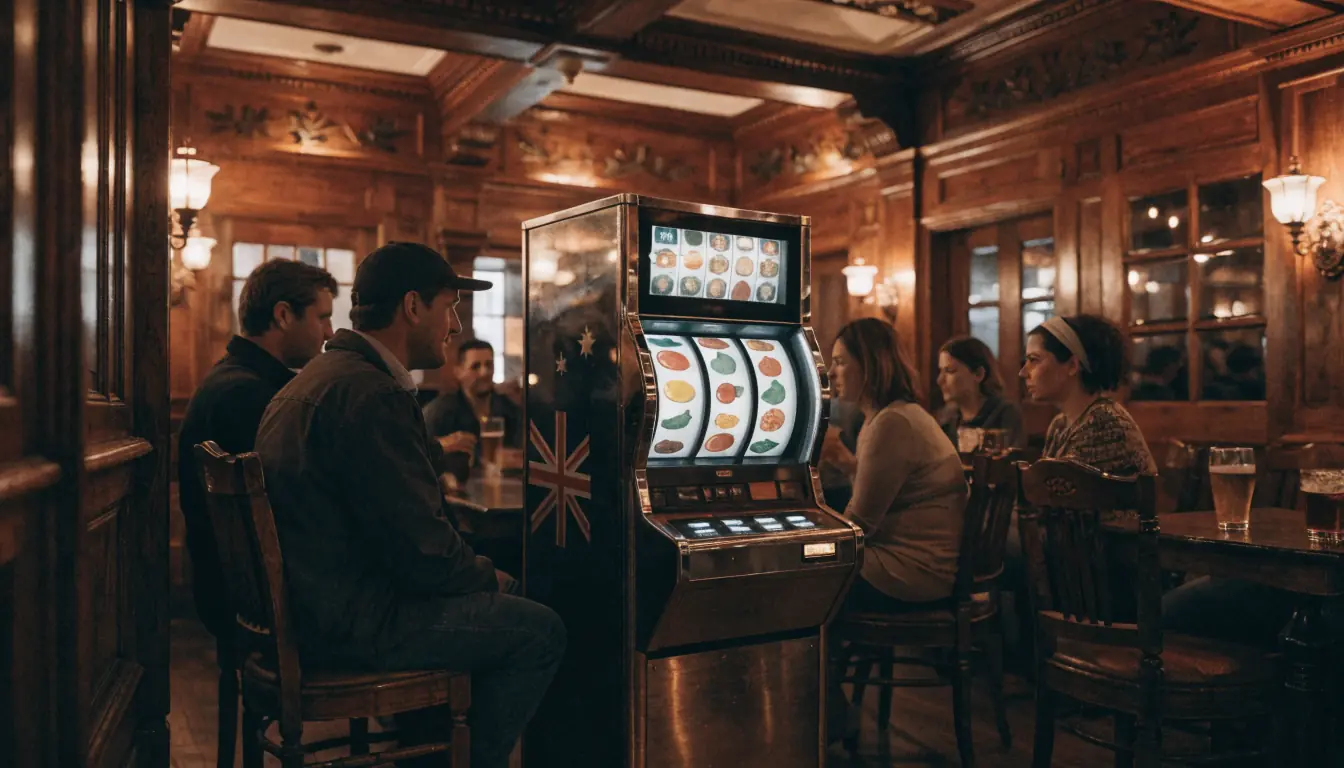
“Pokie machine” and “slot machine” describe the same reel-spinning game; the split is regional, not mechanical. Australians say pokies, a shortened form of “poker machines” that stuck even after the games moved away from poker-based symbols. The rest of the English-speaking world — the UK, the US, most of Europe — defaults to slots or slot machines. A best-paying slot machine and a best-paying pokie machine are, in every practical sense, the same product wearing a different label depending on which side of the Pacific is asking.
That naming habit carries over online without changing anything about how the games function. A search for the best paying pokie machines in Australia and one for the best paying online slot machines return the same category of product: video reels, a return-to-player mechanism, and a random number generator behind both. Marketing copy sometimes uses the terms interchangeably within a single page precisely because the audience does too.
Where the terminology stops being cosmetic
The legal treatment is where "pokie" and "slot" stop being synonyms and start pointing at two different regulatory realities.
Land-based pokie machines in Australian pubs and clubs sit under state and territory gaming legislation — venue licensing, machine caps, harm-minimisation rules enforced locally. That framework has nothing to do with the internet.
Online slots, whatever they’re called, fall under the Interactive Gambling Act 2001 at the federal level. The Act prohibits online casino style games — slots, poker, blackjack, roulette — from being offered to Australian residents by any operator. It doesn’t matter whether the marketing calls the product a pokie or a slot; the classification that matters legally is "online casino game," and that classification is banned outright for providers targeting Australia.
Australia sits toward the strict end of the scale globally on this point: unlike jurisdictions that license and tax domestic online casino operators, Australia has chosen prohibition at the offering side while leaving individual access largely unaddressed. Australian players can legally access offshore crypto casinos that host these same slot and pokie titles, because the IGA regulates operators, not the people clicking spin. No domestic operator can legally offer either a "pokie" or a "slot" online — the terminology is irrelevant to the enforcement, which is aimed entirely at who is doing the offering and from where.

Why offshore operators use "pokies" as a label anyway
Offshore crypto casinos serving the Australian market frequently label their slot libraries "pokies" precisely because that’s the term the audience searches and recognises — not because a separate legal category exists for it. These platforms typically hold offshore licensing through jurisdictions such as Curacao or Malta rather than any Australian authority, since no Australian authority licenses this activity for anyone, domestic or foreign. The licence sits with the operator’s home jurisdiction, not with the player’s location.
That distinction matters more than it looks. A Curacao or Malta licence governs how the operator runs its business — game certification, dispute handling, corporate accountability — not whether an Australian resident is permitted to play. That permission question is already settled by the IGA’s operator-only enforcement, separately from any licence badge on the footer of a site.
The practical takeaway
| Land-based pokies | Online slots/pokies | |
|---|---|---|
| Governed by | State/territory gaming law | Interactive Gambling Act 2001 (federal) |
| Who is regulated | Venues, machine numbers | Operators offering the service |
| Australian licence available | Yes, at venue level | No — not for any provider |
| Player access | Physical presence at licensed venue | Offshore platforms, not prohibited for individuals |
The word choice — pokie or slot — is a dialect difference, not a legal one. What actually separates a machine bolted to a pub floor from the same game running on a browser is the statute that applies to it, and for anything online, that statute is federal, applies only to whoever is offering the game, and doesn’t soften just because the page calls it a pokie instead of a slot.
Online Slot Games – Fairness, Decentralisation and Player Protection
Payout speed and RTP explain why a slot pays well; they say nothing about whether the outcome was ever fair to begin with. That question sits with the mechanism generating the result, not with the marketing around it.
Reputable crypto casinos address it through provably fair algorithms. Each spin generates a cryptographic hash that a player can check independently, confirming that the outcome wasn’t altered after the bet was placed or generated to favour the house on that particular round. This is a different guarantee to an RTP figure published by a game studio — RTP describes an average over a large number of spins, while provably fair verification lets a player confirm a single result was not tampered with. The two checks answer different questions, and a platform offering only one of them is only half-auditing itself.

A smaller group of platforms goes further and runs on decentralised protocols, where no single company holds custody of funds or controls how outcomes are decided. Instead of trusting an operator’s internal systems, the player is trusting code that is open to inspection. Whether that trade-off is worth it depends on how much weight is put on removing a central point of failure versus dealing with a platform that has no support desk in the traditional sense to resolve a dispute.
By one industry review’s account, a few platforms have also introduced native tokens attached to staking rewards and governance rights — letting holders earn on locked tokens or vote on platform decisions. This is not standard across the market; it’s a feature of specific operators rather than a norm to expect by default, and it should be checked against that operator’s own terms rather than assumed.
What player protection covers here
Fairness verification is one layer. Player protection is a separate, broader layer sitting alongside it:
- Outcome verification — the hash-check mechanism described above, specific to provably fair systems.
- Fund segregation or decentralisation — whether player balances sit with the operator or on a protocol the operator doesn’t fully control.
- Access to recourse — a working complaints process, independent of whether the platform is decentralised or conventionally run.
None of this changes the legal position for an Australian player. Playing at an offshore-licensed platform is not an offence for the individual — the Interactive Gambling Act’s restrictions are directed at operators, not at the person placing a bet. That distinction matters here specifically because fairness and legality are separate questions: a game can be provably fair and still sit outside any domestic licensing framework, since no such framework issues casino licences for this market to begin with.
Australian Players – Rights, Legal Access and Verification Requirements
The Interactive Gambling Act 2001 places its restrictions on providers, not on the people using their services. Offering online casino games to Australian residents without local authorisation is what the law prohibits — accessing such a site as a player is not a criminal act under that framework. This distinction matters because it separates what an operator risks from what a player risks, and the two are not the same.
Identity verification remains a condition of doing business with any legitimate offshore operator; skipping it can freeze winnings.
In practice, this means Australian residents can legally access offshore crypto casinos. No provision in the Act criminalises the act of registering, depositing, or playing at a platform licensed outside Australia. The legal exposure sits with the business accepting Australian traffic without proper authorisation, not with the individual placing bets.
That legal standing does not remove practical requirements imposed by the casinos themselves. Identity verification remains a condition of doing business with any legitimate offshore operator, regardless of how funds move. A player depositing in Bitcoin or another cryptocurrency should still expect to submit government-issued ID before a withdrawal is released. Crypto changes how money enters and leaves an account; it does not change who is allowed to hold that account or under what conditions it gets paid out.
This sequencing — play first, verify before cash-out — catches players who assume anonymity extends through withdrawal. It doesn’t. The casino’s own terms, not the Interactive Gambling Act, dictate that checkpoint, and skipping the verification step is the fastest way to turn a winning balance into a frozen one.
Nothing here substitutes for reading an operator’s specific terms before funding an account.
Best‑Paying Real‑Money Slots – Withdrawal Speed and Crypto Bonuses
If you’re chasing strong payout potential from online pokies in 2026, it helps to look beyond flashy homepages and check what each operator actually offers in terms of licensing, bonuses, and deposit terms before you commit real money.
License: Curacao eGaming OGL/2024/923/0383 (Antillephone N.V.) · Bonus: up to A$2,000 + 100 free spins across 2 deposits · Min. deposit: A$30 Licensed under Curacao eGaming, WinSpirit backs new players with a bonus worth up to A$2,000 plus 100 free spins split across two deposits, with a low A$30 minimum deposit making it accessible for smaller bankrolls.
License: Curacao Gaming Authority (Jumpman Gaming Ltd) · Bonus: up to A$6,600 + up to 250 free spins across 4 deposits Operated by Jumpman Gaming under a Curacao Gaming Authority license, DragonSlots offers one of the larger welcome packages on this list, up to A$6,600 and 250 free spins spread over four deposits.
License: Curacao · Bonus: up to A$2,000 Golden Pokies holds a Curacao license and keeps things straightforward with a welcome bonus of up to A$2,000 for new players.
License: Curacao eGaming (Hollycorn N.V., since 2017) · Bonus: 225% up to A$1,540 + 600 free spins across 4 deposits, 20x wagering · Min. deposit: A$20-30 (depends on the offer) Playfina, licensed by Curacao eGaming and run by Hollycorn N.V. since 2017, pairs a 225% bonus worth up to A$1,540 with 600 free spins across four deposits, subject to 20x wagering and a modest A$20-30 minimum deposit.
License: Curacao eGaming (Dama N.V.) · Bonus: up to A$10,000 + 180 free spins, 40x wagering Backed by Dama N.V. under a Curacao eGaming license, JeetCity stands out for its sizeable bonus of up to A$10,000 plus 180 free spins, carrying a 40x wagering requirement.
License: Tobique Gaming Commission · Bonus: up to A$8,000 + 400 free spins across 4 deposits · Payout speed: crypto ~10-15 minutes, fiat 1-5 days · Min. deposit: A$30 Licensed by the Tobique Gaming Commission, SkyCrown offers a bonus up to A$8,000 with 400 free spins across four deposits, and it’s notable for fast crypto withdrawals of around 10-15 minutes alongside fiat payouts of 1-5 days; minimum deposit is A$30.
License: Curacao, operated by Dama N.V. · Bonus: 325% up to 5.25 BTC + 250 free spins across 4 deposits Operated by Dama N.V. under a Curacao license, 7Bit Casino leans into crypto play with a headline bonus of 325% up to 5.25 BTC plus 250 free spins across four deposits.
License: Curacao (operating since 2017) · Bonus: 250% up to A$2,000 + 50 free spins on the first of six deposits · Min. deposit: A$20 Uptown Pokies has been operating under a Curacao license since 2017 and offers a 250% bonus up to A$2,000 with 50 free spins on the first of six deposits, with a low A$20 minimum deposit.
Bonus: 240% up to A$4,100 + 300 free spins WinShark offers a 240% bonus up to A$4,100 alongside 300 free spins for newly registered players.
License: Curacao · Bonus: up to A$10,000 multi-stage + 500 free spins · Min. deposit: A$20 (POLi) Lucky Dreams, licensed in Curacao, features a multi-stage bonus reaching up to A$10,000 with 500 free spins, and accepts a low A$20 minimum deposit via POLi.
Payout speed is where crypto separates itself from card‑based banking. Deposits typically confirm within minutes, so a session can start almost as soon as funds are sent. Withdrawals follow a similar pattern in most cases — clearing within minutes to a few hours, with fees kept low compared to traditional transfers.
That timeline isn’t universal, though. Some withdrawals still depend on the casino’s own approval step before the transaction hits the blockchain, and that review — not the network itself — is what can stretch a payout from minutes into hours. Blockchain confirmation times add a further, smaller variable on top.
Crypto-based bonuses add a separate advantage on top of speed. Because deposits and withdrawals move through the same rails, bonus funds and any winnings from them clear through the same fast process rather than sitting behind separate processing queues reserved for card payments. For a real-money slot player, that combination — quick confirmation plus a bonus structure that doesn’t slow settlement down — is the practical measure of a "best-paying" platform, more than any single payout figure.
Are crypto casinos legal in Australia in 2026?
No domestic licence exists for online casinos, but it is not illegal for Australian players to use offshore crypto casinos. The Interactive Gambling Act targets unlicensed operators offering services to Australians, not the individuals playing on them.
Is using a crypto casino legal for Australian players?
Yes, individual Australians do not commit a criminal offence by accessing offshore-licensed crypto casinos. The law places the regulatory weight and penalties on the operators providing the services, not on the person logging in to play.
Are the games at crypto casinos actually fair?
Reputable platforms use provably fair algorithms based on cryptographic hashes, letting you verify game randomness independently. This lets you confirm fairness directly rather than taking the operator’s assertion on faith.
Can I play on an Australian online casino on mobile?
There are no domestically licensed real-money online casinos in Australia to play on. You can access offshore-licensed platforms on mobile, but there is no locally regulated casino app to use.