
Live Baccarat Online Casino Australia: 2026 Guide

Table of Contents
- Online Casino Landscape in Australia: Licensing and Regulation
- Legal Status of Live Baccarat in Australia
- Understanding Baccarat: Game Mechanics and Variants
- Live Dealer Baccarat: What Australian Players Need to Know
- Evaluating the Best Baccarat Options for Australian Players
- How to Play Baccarat Online: Step‑by‑Step Guide
- Baccarat and Cryptocurrency: Bonuses, Odds, and Compliance
- Top Considerations When Choosing a Baccarat Site
- Online Casinos Offering Baccarat: What to Look For
- Baccarat Rules and House Edge Explained
Online Casino Landscape in Australia: Licensing and Regulation
No domestic licence exists for real-money online casino operation in Australia, and none is on offer. That single fact shapes everything else in this section: there is no register to check, no local regulator issuing casino permits, and no path to legal domestic operation for anyone looking to run one. Australians who search for baccarat casinos online are, by definition, looking offshore — a point the next section deals with directly. Here, the concern is narrower: who regulates what, and why the answer to "who licenses online casinos in Australia" is, in practice, nobody.
Why there is no single regulator
Australia does not have one overarching gambling law or one body that oversees the whole sector. Regulation is split between the Commonwealth and the states and territories, each with its own remit and its own blind spots. At the federal level, the Australian Communications and Media Authority (ACMA) enforces the Interactive Gambling Act 2001, which is the closest thing to a national framework for online gambling. But ACMA’s enforcement power is aimed at stopping prohibited services from reaching Australian residents — it does not license anything, because there is nothing federal to license. Offering an online casino to Australians is illegal outright, and no application process exists to make it legal.
Below the federal layer, every state and territory runs its own gambling regulator, and these bodies were built for a different job than the one live baccarat casinos raise. The Victorian Gambling and Casino Control Commission (VGCCC), for instance, monitors wagering service providers — including ones based outside Victoria — for compliance with the National Consumer Protection Framework. Liquor & Gaming NSW does comparable work in New South Wales. Both operate with real authority over licensed betting operators within their jurisdiction, but that authority thins out fast once the operator in question is based offshore and never sought an Australian licence in the first place. A state regulator can act against a bookmaker it licensed; it has far less it can do about a casino site hosted in another country that never asked permission to operate here.

The Northern Territory Racing Commission (NTRC) occupies an odd position in this structure. It is not the national regulator on paper, but it functions as one in practice, because it licenses the majority of Australia’s online bookmakers — largely due to more favourable tax treatment in the Territory. That arrangement explains why so many wagering brands operating nationally carry an NT licence regardless of where their customers are based. It is worth being precise about what that licence covers, though: it applies to sports and race betting operations, not to online casino products. Baccarat, blackjack, and similar table games sit outside what any Australian state or territory regulator — NTRC included — is set up to license.
Land-based casinos sit in a separate system entirely
Physical casinos in Australia — the venues where baccarat tables have operated for decades — answer to a different set of rules altogether. These are licensed and policed by state government regulators and law enforcement agencies, under frameworks built for bricks-and-mortar gaming floors: physical premises, on-site compliance checks, local employment and taxation conditions. None of that machinery extends to the internet. A state’s authority over its licensed land-based casino has no equivalent reach over an online casino operating from outside Australia, even one offering the exact same game. The two are regulated as if they were unrelated industries, because as far as Australian law is concerned, they largely are.

What this means for offshore casino sites
Put the pieces together and the shape of the market becomes clear: there is no licensing body an offshore casino can apply to in Australia, no Australian regulator with enforcement teeth over a server sitting overseas, and no state authority whose consumer protection framework was designed with international online casinos in mind. VGCCC and Liquor & Gaming NSW can and do monitor wagering providers for compliance, but their practical leverage stops well short of the offshore casino operators most Australians researching baccarat sites will actually encounter. These operators typically hold licences from jurisdictions such as Malta or the UK, issued by regulators such as the Malta Gaming Authority or the UK Gambling Commission — bodies with no jurisdiction in Australia and no obligation to answer to one.
This is not a gap anyone is quietly working to close. It is the structural reality of how Australian gambling law was written: state and territory regulators cover licensed wagering and land-based venues within their own borders, ACMA polices access to prohibited services at the federal level, and the space in between — an offshore online casino serving Australian customers — belongs to no one’s licensing regime. That absence of a domestic casino licence is the fact that every subsequent discussion of baccarat in Australia has to be read against. It is also why any site claiming an "Australian gambling licence" for its casino operation is making a claim that cannot be true, since no such licence has ever existed to grant.
The regulatory map, in short:
| Level | Regulator | Covers | Casino licensing power |
|---|---|---|---|
| Federal | ACMA | Enforcement of the Interactive Gambling Act 2001 | None — enforces prohibition, does not license |
| Territory | NTRC | Licensing of most national online bookmakers | Sports/race betting only, not online casino |
| State | VGCCC (Victoria) | Wagering providers, consumer protection compliance | Limited reach over offshore operators |
| State | Liquor & Gaming NSW | Wagering providers in NSW | Limited reach over offshore operators |
| State | Various | Land-based casinos and venues | Physical premises only, no online equivalent |
Nothing in this table produces an Australian online casino licence, because that outcome does not exist within the current legal structure — a detail the following section builds on when it turns to what this means specifically for baccarat.
Legal Status of Live Baccarat in Australia
The law that decides whether live baccarat is available to an Australian player is the Interactive Gambling Act. Sources disagree on which version applies: some reference the Interactive Gambling Act 1997 as the instrument prohibiting online casino games for Australian residents, others cite the Interactive Gambling Act 2001 as the operative Commonwealth statute. The discrepancy is worth stating plainly rather than resolving by guesswork, since the two dates appear in different official and legal summaries without a clear reconciliation. What both versions agree on is the substance: providing online casino games, including baccarat dealt online, to people in Australia is prohibited.
That prohibition, however, is written to catch operators, not the people placing bets. The Interactive Gambling Act was framed around harm minimisation, and its enforcement mechanism targets whoever offers the service — the company running the tables, not the person sitting at a laptop or phone. It is not illegal for an individual Australian to play live baccarat at an offshore-licensed online casino. No player has been prosecuted for logging into a table hosted from another jurisdiction, and no provision of the Act criminalises that behaviour. The offence sits entirely on the supply side.
Two different questions, one law
This produces a split that trips people up if it isn’t stated separately:
- Can an Australian company legally offer live baccarat to Australian residents? No. There is no path to a domestic licence for this kind of product, and offering it anyway is a breach of the Act.
- Can an Australian resident legally play live baccarat at a site licensed somewhere else? Yes, in the sense that the Act does not make the player’s participation an offence.
Those two answers coexist without contradiction because the statute was built to regulate supply, not demand. It is the same logic that lets ACMA pursue operators and order blocking of their websites while leaving individual account holders alone.
What "offshore" actually means here
Live baccarat, when Australians access it, is coming from a platform licensed and hosted outside Australia — commonly in jurisdictions such as Malta or the UK, under regulators like the Malta Gaming Authority or the UK Gambling Commission. These bodies license the operator for the market they were established to serve; none of them issues a licence that authorises service into Australia, because no such Australian licence exists to align with. The operator’s licence is real, but it does not make the offering legal for the Australian market — it simply means the company answers to a foreign regulator for how it treats its licensed customer base, wherever they log in from.

This is why a live baccarat table appearing on a screen in Sydney or Perth is not evidence of anything being locally sanctioned. The table is running under a jurisdiction that permits it, reached over the open internet by a player whose own government has not authorised the offering but has also chosen not to criminalise the act of playing.
Where enforcement actually lands
Because the Interactive Gambling Act is aimed at suppliers, the practical consequences of non-compliance fall on the operator and its infrastructure, not on the account holder. That distinction matters when weighing the legal status of a live baccarat session: the game itself is not sanctioned by any Australian authority, no Australian entity is permitted to run it, and yet the person placing the bet is not committing an offence by doing so. The absence of a domestic licensing regime for this category is a permanent feature of the law, not a temporary gap waiting to be filled — the Act was written on the premise that this class of product would not be authorised inside Australia at all.

Anyone assessing a live baccarat site’s legitimacy has to keep those two facts separate: the operator’s standing under its own foreign licence, and the fact that no Australian approval applies to what is being played. Conflating the two — treating a Malta Gaming Authority licence, for instance, as proof of Australian legality — misreads what that licence covers. It authorises the business to operate under Maltese law. It says nothing about the operator’s standing under the Interactive Gambling Act, because no such standing is available to obtain.
Understanding Baccarat: Game Mechanics and Variants
Baccarat runs on arithmetic, not psychology. Two hands are dealt — Player and Banker — and the bet resolves on which hand’s total sits closer to nine. Cards two through nine count at face value, tens and face cards count as zero, and aces count as one. When a hand’s total exceeds nine, only the second digit counts: a seven and an eight, totalling fifteen, register as five. There is no drawing strategy to master, no decision tree to memorise. The dealer or the software follows a fixed table of drawing rules, and the hand plays itself out.

Three outcomes are available: Player wins, Banker wins, or a Tie. A hand of eight or nine dealt from the first two cards is a "natural," and no further cards are drawn. Outside of a natural, a third card may be dealt to either hand according to a set of rules baked into the game rather than left to the punter’s judgement. This is the core distinction between baccarat and games like blackjack: there is nothing to optimise mid-hand, which is part of why it has held its position as a staple casino game across markets that otherwise diverge sharply on regulation.
Standard Variants
The name "baccarat" covers a handful of related games that differ mainly in who deals, who can decide on the third card, and how the commission on Banker bets is handled.
- Punto Banco — the version most commonly offered as “baccarat” in online lobbies. All draws follow fixed rules; no player input affects the third-card decision. This is the standard format behind most random number games and live-streamed tables alike.
- Chemin de Fer — a version where players take turns acting as Banker and retain some discretion over drawing a third card. Rare in online formats, more associated with traditional European casino floors.
- Baccarat Banque — similar in spirit to Chemin de Fer but with a more fixed banking arrangement across a shoe of cards.
- Mini Baccarat — a scaled-down table format, same underlying rules as Punto Banco, dealt by a single croupier rather than a full table crew.
Speed variants and side-bet versions (pairs, small/big bets, dragon bonuses) exist as well, layering additional wagers onto the same base mechanics without changing how the main hand resolves.
Random Number Games versus Physical Shoes
Online, baccarat is offered in two structurally different ways. One is a random number game, where outcomes are generated algorithmically and displayed on screen without a physical card shoe. The other replicates a physical deal — either through a live-streamed table with a croupier or, in retail venues, an actual dealer working a shoe of cards. The house edge and drawing rules are identical between the two; what changes is how the outcome is produced and verified. This distinction matters more in regulatory terms than in gameplay terms, and it is the dividing line explored separately in the section on live dealer baccarat.
Where Baccarat Sits Under Australian Law
Mechanically, baccarat belongs to the same family of games as roulette and blackjack — outcome-driven, no ongoing skill component during play — and Australian law treats it accordingly. Online casino style games, including slots, poker, blackjack, and roulette, are prohibited under the Interactive Gambling Act 2001, and baccarat falls within that same prohibited category when offered as an online casino product. Online casino play generally, alongside poker and in-play betting, is prohibited federally under the same Act. That prohibition sits on the offering side of the transaction, a point covered in more depth in the section on baccarat’s legal status, but it is worth flagging here because it shapes which format of the game a player in Australia will actually encounter: not a domestically hosted casino table, but an offshore one.
The in-play distinction carries a separate wrinkle worth noting purely as a matter of game mechanics. Live, in-play online betting is illegal in Australia, while live betting placed by phone remains legal — a split that has nothing to do with baccarat’s card-drawing rules and everything to do with how a live-dealt hand is classified once wagering happens in real time rather than on a pre-set outcome. It is one of the reasons "live" baccarat sits in its own regulatory category rather than simply being baccarat played faster.
Reading a Baccarat Table
A baccarat scorecard or road map — the grid of red and blue marks seen at physical and live tables — records the sequence of Player, Banker, and Tie results. It has no bearing on the fixed drawing rules and does not predict future outcomes; each hand is dealt independently of the last. Its function is informational, not strategic, though it remains one of the more recognisable visual features of the game across every variant and delivery format.
Across all of this — Punto Banco, Chemin de Fer, mini tables, random number generators, live streams — the underlying arithmetic never changes. What changes is presentation, pacing, and, as the next section covers, the compliance questions specific to a dealer working in real time.
Live Dealer Baccarat: What Australian Players Need to Know
A live dealer baccarat table differs from a standard random-number-generator game in one respect that matters legally as much as practically: a croupier deals real cards on camera, streamed to players in real time. For compliance purposes, though, the distinction is irrelevant. Live dealer baccarat is still an online casino game, and online casino games remain prohibited for operators serving Australian residents regardless of whether the shoe is shuffled by software or by hand.
This is where live dealer baccarat creates a compliance problem that a purely computer-generated table does not. Streaming infrastructure, croupier studios, and real-time card recognition all sit with the operator, typically offshore, and none of that changes the underlying legal status of the offer. No amount of production quality converts a prohibited product into a permitted one.

What ACMA enforcement actually targets
The Australian Communications and Media Authority has, since November 2019, been able to order internet service providers to block offshore gambling sites found to be operating illegally in Australia. Live dealer baccarat platforms fall squarely within that enforcement scope, since they offer exactly the kind of online casino game the Interactive Gambling Act 2001 was built to keep out of the domestic market.
By one account, more than 100 illegal gambling services, including online casinos, had exited the Australian market since ACMA began enforcing new rules in 2017. A later figure put the number of blocked illegal gambling and affiliate websites at 975 since November 2019, as of a 2024 publication — while a separate source cites 1,296 blocked sites and affiliates by August 2025, with over 220 services having voluntarily exited. The figures don’t agree, and it isn’t clear whether they’re counting the same thing: blocked domains, exited operators, and affiliate sites are not interchangeable categories, and different sources appear to mix them.
What that means practically for a live dealer baccarat platform is straightforward: it can be reachable one week and blocked at the ISP level the next, with no notice given to the player mid-session. A live table doesn’t pause gracefully when a domain gets added to a blocking order — the game simply becomes unreachable through that address.
Where the risk actually sits
None of this makes it illegal for an individual in Australia to sit at an offshore live dealer table. The law targets the operator offering the service, not the person playing it. But enforcement risk against the operator translates into practical risk for the player: a blocked domain, a platform that quietly stops serving Australian traffic, or a live studio that shuts down entirely.
| Factor | Standard RNG baccarat | Live dealer baccarat |
|---|---|---|
| Legal status for operator | Prohibited | Prohibited |
| Legal status for player | Not illegal to access offshore | Not illegal to access offshore |
| Exposure to ACMA blocking orders | Yes | Yes |
| Continuity risk if domain blocked | Game unavailable | Live session interrupted mid-play |
A live dealer table adds nothing to the legal picture — it’s still an offshore casino offer sitting outside the licensed Australian gambling framework, which covers sports and racing wagering and lotteries, not casino games. What it adds is a layer of operational fragility: streaming infrastructure and studio operations that depend on the platform staying reachable, at a time when ISP-level blocking orders are an active and ongoing enforcement tool rather than a one-off measure.
Evaluating the Best Baccarat Options for Australian Players
Before diving into live baccarat tables, it’s worth checking how each casino is licensed, what welcome offer covers your first deposits, and how fast you can get started so you can pick a room that suits your bankroll and comfort level.
License: Curacao eGaming OGL/2024/923/0383 (Antillephone N.V.) · Bonus: up to A$2,000 + 100 free spins across 2 deposits · Min. deposit: A$30 Licensed under Curacao eGaming via Antillephone N.V., this casino offers a multi-deposit welcome package worth up to A$2,000 plus 100 free spins, with a low A$30 minimum deposit making it easy to get started.
License: Curacao Gaming Authority (Jumpman Gaming Ltd) · Bonus: up to A$6,600 + up to 250 free spins across 4 deposits Operated by Jumpman Gaming Ltd under a Curacao Gaming Authority license, it stands out for a generous four-deposit welcome bonus reaching up to A$6,600 and 250 free spins.
License: Curacao · Bonus: up to A$2,000 A Curacao-licensed casino offering a welcome bonus of up to A$2,000, giving new players a straightforward starting boost.
License: Curacao eGaming (Hollycorn N.V., since 2017) · Bonus: 225% up to A$1,540 + 600 free spins across 4 deposits, 20x wagering · Min. deposit: A$20-30 (depends on the offer) Backed by Hollycorn N.V. and licensed under Curacao eGaming since 2017, this casino provides a 225% bonus up to A$1,540 with 600 free spins across four deposits, clear 20x wagering terms, and a low entry deposit of A$20-30.
License: Curacao eGaming (Dama N.V.) · Bonus: up to A$10,000 + 180 free spins, 40x wagering Licensed via Curacao eGaming under Dama N.V., it offers one of the larger welcome packages on this list, up to A$10,000 plus 180 free spins, with 40x wagering requirements.
License: Tobique Gaming Commission · Bonus: up to A$8,000 + 400 free spins across 4 deposits · Payout speed: crypto ~10-15 minutes, fiat 1-5 days · Min. deposit: A$30 Licensed by the Tobique Gaming Commission, it combines a substantial four-deposit bonus up to A$8,000 with 400 free spins, plus notably fast crypto payouts of around 10-15 minutes and fiat withdrawals within a few days.
License: Curacao, operated by Dama N.V. · Bonus: 325% up to 5.25 BTC + 250 free spins across 4 deposits Operated by Dama N.V. under a Curacao license, this crypto-friendly casino offers a striking 325% bonus up to 5.25 BTC plus 250 free spins across four deposits.
License: Curacao (operating since 2017) · Bonus: 250% up to A$2,000 + 50 free spins on the first of six deposits · Min. deposit: A$20 Running since 2017 under a Curacao license, it offers a 250% bonus up to A$2,000 with 50 free spins on the first of six deposits, and a low A$20 minimum deposit.
Bonus: 240% up to A$4,100 + 300 free spins This casino offers a solid welcome package of 240% up to A$4,100 plus 300 free spins for new players.
License: Curacao · Bonus: up to A$10,000 multi-stage + 500 free spins · Min. deposit: A$20 (POLi) Licensed in Curacao, it features a multi-stage bonus reaching up to A$10,000 with 500 free spins, and a low A$20 minimum deposit via POLi.
No Australian regulator licenses online casino baccarat, and no domestic register exists to check an operator against. "Best" therefore cannot mean best-licensed-locally — that category is empty by law. What remains is a narrower, more useful question: among offshore-licensed sites Australians actually use, which signals separate a defensible choice from a reckless one.
What "best" can realistically mean here
Since a local seal of approval isn’t available, the assessment shifts to verifiable substitutes:
- Offshore licence transparency. An operator should state, plainly, which jurisdiction licensed it and display that licence number. A missing or vague licensing claim is not a minor omission — it’s the first disqualifier.
- Age and identity checks. Sites worth considering enforce 18+ access and require government-issued ID before withdrawal. Anything less is a compliance failure, not a convenience trade-off.
- Bankroll controls. The option to set deposit, loss, or time limits should exist before money moves, not buried in a settings menu discovered later.
- Bonus terms stated up front. Wagering conditions attached to any welcome offer should be visible before the offer is accepted — not disclosed only in a terms page found after the fact.
- Complaint and dispute pathways. A working complaints process, ideally with reference to an alternative dispute resolution body, indicates the operator expects to be held accountable rather than simply hoping disputes never surface.
- Payment discipline. Sites that accept credit cards or crypto for baccarat deposits are stepping outside the boundaries operators are expected to respect; their absence from a payment menu is a point in an operator’s favour, not a limitation.
- Responsible-gambling messaging. Advertising and promotional material should carry harm-reduction information as standard, not as an afterthought in small print.
What "best" cannot mean
It cannot mean domestically regulated, because that category doesn’t exist for online casino baccarat in Australia. It cannot mean appearing in a public licensee register, because no such register is kept for this activity. And it cannot mean guaranteed odds or payout advantages beyond what the game’s fixed house edge already dictates — no operator alters the mathematics of baccarat in a player’s favour.
The enforcement backdrop worth weighing
According to iclg.com, as of August 2025 the Australian Communications and Media Authority had blocked 1,296 illegal gambling sites and affiliates since 2019, with 220 services voluntarily exiting the market. That figure says less about any single operator’s quality and more about the churn in this space: a site accessible today may be blocked tomorrow, and the identity behind a brand can change without much public notice. Judging an option by its current appearance alone is unreliable; judging it by whether it publishes verifiable licensing, enforces identity checks, and discloses bonus terms before asking for a deposit is a sturdier, if less exciting, standard.
None of this produces a ranked shortlist. It produces a filter — and most offshore baccarat sites fail at least one part of it.
How to Play Baccarat Online: Step‑by‑Step Guide
Setting up an account on an offshore platform follows a consistent sequence regardless of which baccarat table a player picks. The mechanics below describe that sequence, not any endorsement of a particular operator.

Registration and identity checks
Account creation starts with basic details — name, date of birth, email, residential address. Because offshore operators still apply anti‑money‑laundering standards, identity documents are typically requested before a withdrawal is processed, even though they may not be required at signup. A passport or driver’s licence, sometimes paired with a proof‑of‑address document, is the usual request. Age is checked at this stage as well; the account will not proceed if the details indicate the applicant is under 18.
Funding the account
Deposits go through the cashier section, where payment options are listed with their processing behaviour. Common routes include bank transfer services such as PayID, along with e‑wallets and prepaid cards, depending on what the platform supports. Whatever the method, the deposited balance appears as site credit — the operator does not extend gambling on borrowed funds, so the amount sitting in the account is the amount available to bet.
Finding the table
Baccarat sits in a dedicated table‑games or live‑dealer lobby, usually filterable by stake size and variant. A table layout, whether virtual or streamed from a studio, shows three betting zones: Player, Banker, and Tie. Some tables also display a scoreboard tracking recent outcomes, though this history has no bearing on the next hand.
Placing a bet
Before cards are dealt, chips are placed on one of the three zones:
- Player — wagering that the Player’s hand will have the higher value.
- Banker — wagering that the Banker’s hand will have the higher value.
- Tie — wagering that both hands will finish equal.
Betting closes once the round starts, either by an on‑screen timer in a live stream or a fixed interval in a computer‑dealt version.
Dealing and settlement
Two cards go to Player and two to Banker. Values above nine drop the leading digit — a nine and a seven, for instance, total sixteen, which counts as six. A third card is drawn for either hand under fixed rules built into the game itself, not decided at the table. Once both hands are complete, the higher total wins and winning bets are settled automatically; losing bets are cleared from the layout. Live dealer versions show the croupier turning and totalling the cards on camera, while computer‑dealt tables resolve the same rules instantly through random number generation.
Withdrawing winnings
Cashing out routes back through the same verification process noted at registration — identity documents are checked before funds are released, a standard anti‑money‑laundering step rather than a sign of trouble. Processing times and methods available for withdrawal vary by operator and are worth checking in the cashier section before playing, since not every deposit method supports a matching withdrawal route.

None of the above changes the fact that engaging with any of these platforms happens outside Australian licensing. By one account, more than 220 illegal gambling services have ceased operating in the country following enforcement action — a reminder that the offshore landscape shifts, and a platform accessible today is not guaranteed to remain so.
Baccarat and Cryptocurrency: Bonuses, Odds, and Compliance
Bitcoin and Ethereum have become common deposit and withdrawal methods on offshore platforms offering baccarat, sitting alongside — and on some sites replacing — traditional fiat rails. The appeal is speed and distance from a domestic banking system that has no legal standing to process these transactions in the first place, since no online casino is licensed to operate within Australia regardless of the currency used.
Crypto bonuses attached to baccarat tables are marketed the same way fiat bonuses are: deposit matches, cashback, occasional loyalty tiers. What changes is the settlement currency, not the underlying commercial logic. A bonus denominated in bitcoin still carries wagering requirements, and those requirements should be disclosed before the bonus is accepted rather than discovered at withdrawal. Whether a given operator does this consistently, or how its crypto bonus terms differ from its fiat ones in practice, is not something that can be verified from public regulatory sources — operators disclose what they choose to disclose, and there is no register cross-checking their claims.
Odds do not move with the currency
The house edge on baccarat — banker, player, or tie — is a function of the bet type and the shoe, not of whether the wager is settled in dollars or bitcoin. Cryptocurrency changes how money moves in and out of an account; it does not change the mathematics of the game sitting on the felt. Any claim that crypto tables offer better odds than fiat tables should be read as marketing, not as a statement about the game itself.
Where compliance actually bites
The Australian Communications and Media Authority can request that internet service providers block websites offering games not permitted under Australian law, including online casinos. That power applies to the site itself — the domain hosting the baccarat tables — not to the payment rail a player chooses to fund an account. A platform is not made more or less compliant by accepting Bitcoin instead of a bank card; if the underlying casino offering is unlicensed for the Australian market, the currency used to deposit into it is beside the point.

This matters for anyone weighing a crypto bonus against a fiat one: the regulatory exposure sits with the operator’s licensing status, not with the wallet address. No amount of blockchain transparency substitutes for a licence that does not exist domestically. What a crypto deposit does offer is a paper trail on a public ledger — useful for a player’s own records, irrelevant to whether the site itself is operating within Australian law.
Reading a baccarat scoreboard
The bead-road or scoreboard displayed at live baccarat tables — tracking recent banker, player, and tie outcomes — functions identically whether the table is funded in fiat or crypto. It is a record of past results, not a signal of what the shoe will do next; treating it otherwise is a common misreading of a tool that exists for pattern tracking, not prediction.
Top Considerations When Choosing a Baccarat Site
No Australian regulator issues a domestic licence for online casino games, so a baccarat site cannot be assessed against a local registry. The practical checklist looks elsewhere.
Offshore licensing. A site accepting Australian players operates under a foreign licence — Malta or the UK, for example. That licence governs the operator, not Australian consumers, but its presence indicates some external oversight where none exists domestically.
How the site reached the player. Legitimate advertising channels for offshore casinos are narrow, since promoting online casino services on social media or other platforms is not permitted here. A site relying heavily on social ads or affiliate promotion to reach Australian users is already operating outside the rules that would apply to it if it were a domestic-facing business — worth noting given ACMA itself cannot force platforms like Facebook to pull such ads targeting Australia.
Payment handling. Deposits made by credit card or digital currency conflict with restrictions that apply to compliant advertising and payment practices, so how a site processes funds says as much as its licence does.
Verification and account controls. Identity checks before withdrawal, and tools to set limits, point toward an operator treating compliance as more than decoration.
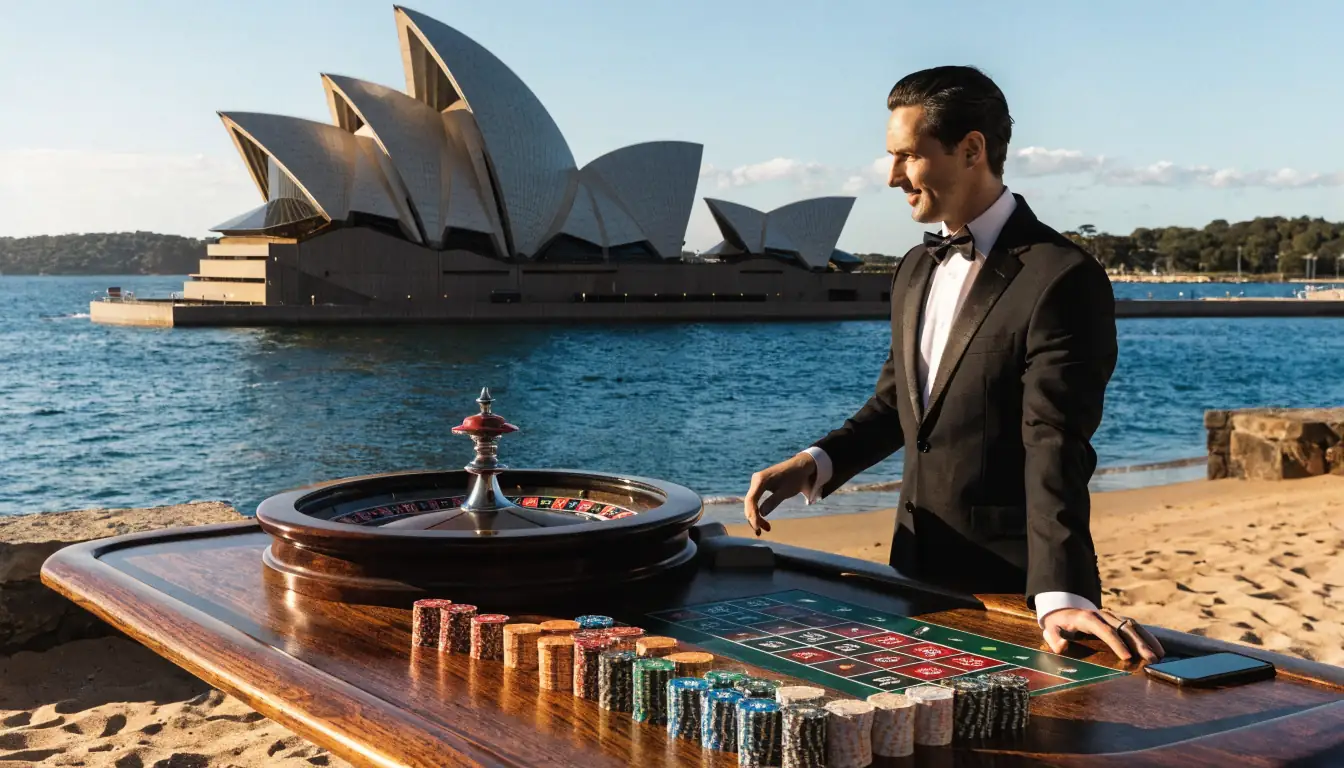
None of this produces a ranking — only a shorter list of sites worth examining further.
Online Casinos Offering Baccarat: What to Look For
A site hosting baccarat tables reveals itself through details that have nothing to do with the cards. Table variety matters less than how the software runs: whether the video feed holds up without lag, whether bet limits are stated plainly before a hand starts, and whether the croupier’s actions match the on-screen result without delay.
Account and payment mechanics say more than marketing copy. A withdrawal request that stalls, or an identity check that appears only once money is due to leave, points to friction worth noting before depositing anything.
Support channels are the other test. A live chat that answers with a name and a clear process differs from one that recycles scripted replies. None of this substitutes for a licence check, since no such register exists for these operators. It’s also worth remembering that ACMA can investigate and block an illegal service, but it has no mechanism to recover a player’s funds or settle a dispute with an offshore operator — so the site’s own dispute process is what actually matters in practice.

Baccarat Rules and House Edge Explained
Baccarat runs on a fixed set of rules the croupier applies without discretion. Two hands are dealt — Player and Banker — each starting with two cards, with a third card drawn to either hand according to a set drawing table rather than any decision by the participants. Card values run zero to nine; totals above nine drop the tens digit, so a nine and a seven make six, not sixteen. The hand closest to nine wins.
Bets fall into three categories: Player, Banker, and Tie. The Banker bet carries a small commission on wins, which is where most of the statistical house edge sits. Player and Tie bets carry a separate, generally higher house edge, with Tie being the least favourable of the three over repeated play.
None of this changes depending on where the game is hosted or who deals it. What varies — licensing, dealer format, payment method — belongs to those decisions, not to the rules themselves, which stay identical at every table.
How can a player verify that an online casino holds a valid licence in Australia?
They cannot, because no domestic online casino licence exists in Australia to verify. Any site claiming an Australian casino licence is making a claim that cannot be true.
Is online gambling legal in Australia?
Online sports betting is legal under state and territory licences, but offering online casino games like baccarat to Australian residents is federally prohibited. It is not illegal for individuals to play at offshore casinos, as the law targets operators, not players.
Where can I complain about an online casino in Australia?
ACMA can investigate and block prohibited gambling services, but it cannot recover funds or settle individual disputes with offshore operators. State regulators also have limited power over offshore casinos, leaving no domestic body to effectively resolve complaints.